Table of Contents
- Signs of Worn Out Sliding Door Rollers
- Sliding Door Roller Replacement Tools You’ll Need
- Step-by-Step Roller Replacement Process
- Cost to Fix Sliding Door Rollers: What to Expect
- Roller Compatibility Guide: Matching Rollers to Your Door
- Troubleshooting Non-Roller Issues
- Why Choose a Professional Sliding Door Rollers Replacement Service
- Conclusion
- Frequently Asked Questions
Last Updated: September 14, 2026
Signs of Worn Out Sliding Door Rollers
A sliding door that grinds, jumps its track, or needs a shoulder behind it to open is usually telling you its rollers are finished. The sliding door rollers are the small wheels inside the bottom or top rail that carry the full weight of the panel, so when they wear flat or seize up, every opening and closing gets harder.
Watch for these symptoms:
- Grinding or scraping as the panel moves, caused by metal-on-metal contact once the wheel surface wears through
- The door drags or sticks no matter how clean the track is
- The panel sags and catches on the door threshold or frame
- Visible flat spots or cracks on nylon wheels, or rust on steel ball bearings
- The door comes off its track repeatedly, a sign of a collapsed roller housing
A common mistake is assuming a stiff door always needs new rollers. Sometimes it is track debris or a misaligned frame. Test the panel by lifting it slightly as you slide it; if it moves freely when lifted, the rollers are the problem, not the track.
Before ordering parts, slide the door halfway open and look at the gap between the bottom rail and the track. If you can see daylight under the panel, the roller has likely collapsed and the door is riding on its frame.
Sliding Door Roller Replacement Tools You’ll Need
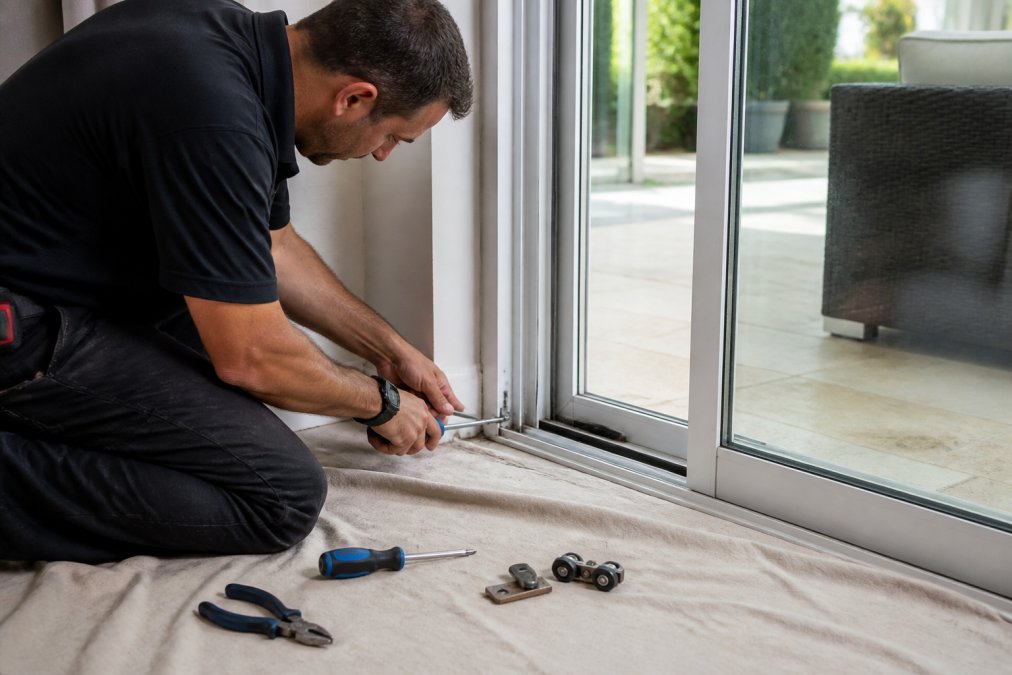
Most sliding door roller replacement tools are already in a basic homeowner’s kit. You do not need specialty equipment for a standard bottom-mounted roller swap on a sliding glass door.
Gather these before you start:
- Flathead and Phillips screwdrivers for adjustment screws and roller housing fasteners
- A putty knife or flat pry bar to lift the panel without damaging the door frame
- A vacuum and stiff brush for clearing track debris
- Replacement rollers matched to your door’s weight and rail type
- A drop cloth to protect flooring and catch small fasteners
- Silicone-based lubricant for the new gliding mechanism
For heavier impact glass panels, you may also want a second person and a set of suction cup lifters. A single panel of impact glass can weigh well over 45 kilograms, and dropping it means a replacement, not a repair (gsa.gov).
Never use WD-40 or oil-based sprays on the track (HUDClips). They attract dust and grit, which accelerates wear on the nylon wheels and steel ball bearings. Use a dry silicone lubricant instead.
Step-by-Step Roller Replacement Process
Roller replacement follows a predictable sequence: remove the panel, swap the hardware, then reinstall and test. Expect the job to take 30 to 60 minutes per door for a straightforward bottom-mounted setup (How to Repair a Sliding Door (DIY)).

Remove the Door Panel
Lift the panel straight up into the upper track until the bottom rollers clear the lower rail, then tilt the bottom edge toward you and walk it out. On most doors, one or two adjustment screws raise the rollers enough to give you the clearance you need. Set the panel flat on a padded surface, glass side up, so the roller housing is accessible.
Swap Out the Old Rollers
Unscrew the old roller assembly from the bottom rail and pull it free. Match the new roller to the old one by wheel diameter, housing shape, and mounting hole spacing. Seat the new assembly, thread the fasteners by hand first, then snug them down. Confirm the adjustment screw turns freely before you reinstall the door.
Reinstall and Test the Door
Set the panel back into the upper track, tilt it upright, and lower it onto the bottom rollers. Slide it through its full range and check for drag. Turn the adjustment screw to raise or lower the panel until it clears the threshold evenly and the door sweep seals against the frame. Lock the door and confirm the latch lines up.
| Step | Time | What to Check |
|---|---|---|
| Remove panel | 5-10 min | Rollers clear the bottom track |
| Swap rollers | 10-20 min | Wheel size and hole spacing match |
| Reinstall and test | 10-20 min | Even clearance, smooth glide, latch aligns |
Cost to Fix Sliding Door Rollers: What to Expect
The cost to fix sliding door rollers depends on door weight, roller type, and whether the track also needs work. A single standard roller swap costs far less than a full panel or track replacement, which is why repair is almost always the smarter first move.
Factors that move the price:
- Door weight and glass type: impact glass and heavy panels need heavier-duty rollers and often two people
- Roller count: some panels use a tandem roller assembly with two wheels per housing
- Track condition: a bent or corroded track adds labor and materials
- Access: second-story, tight pocket door, or enclosed patio openings take longer
- Urgency: same-day or after-hours service may carry a premium
Pricing for any specific job depends on the door, the parts, and the access, so the reliable way to get a real number is a written estimate. Smooth Sliders offers free estimates, which means you can see the scope and cost before committing.
Get a written estimate that separates parts from labor. If a quote bundles the roller cost into a single lump sum, ask what the rollers alone cost so you can judge the labor fairly.
Roller Compatibility Guide: Matching Rollers to Your Door
Roller compatibility comes down to four specs: wheel diameter, housing shape, mounting hole spacing, and load-bearing capacity. Get any one of these wrong and the door will not ride correctly, no matter how well you install it.
Sliding door rollers fall into two main families. Bottom-mounted rollers sit in the bottom rail and carry the panel’s weight on the lower track. Top-hung rollers hang the panel from an upper track and are common on pocket doors and heavier commercial systems. They are not interchangeable.
Identifying Rollers on Older or Discontinued Doors
This is where most DIY replacements fail. A door installed 15 or 20 years ago may use a roller that is no longer stocked at big-box retailers, and the brand plate on the door frame is often the only clue. Here is how to work through it:
- Find the manufacturer label. Look on the top or side of the door frame, inside the jamb, or on the glass etching. Brands like Andersen, Pella, Milgard, and Jeld-Wen have used consistent roller families for decades, and a model number narrows the search fast.
- Measure the old roller before ordering. Wheel diameter (in millimeters), housing width and height, and the distance between mounting screw holes are the three numbers that matter most. A caliper or a ruler photographed next to the roller works.
- Check the track profile. Some rollers are shaped to fit a specific rail cross-section. A roller that matches the door but not the track will bind.
- Search by door model, not by roller description. Supplier catalogs and manufacturer parts diagrams are indexed by door model number. Searching “sliding door roller 1-1/4 inch nylon” returns hundreds of near-matches; searching your door’s model number returns the right one.
- When the brand is gone, match by dimension. If the manufacturer is out of business, a specialty hardware supplier can cross-reference the measurements to a current equivalent. Bring the old roller, or a photo with a ruler, in person.
Wheel Material: Nylon vs. Steel vs. Delrin
| Material | Best For | Trade-off |
|---|---|---|
| Nylon | Standard residential glass and closet doors | Quiet, but can flat-spot under very heavy loads |
| Steel (ball bearing) | Heavy panels, impact glass, high-traffic doors | Durable, but noisier and can rust in humid climates |
| Delrin (acetal) | Mid-weight doors, coastal or humid environments | Smooth and corrosion-resistant, higher cost |
When matching a replacement:
- Measure the old wheel diameter in millimeters and match it exactly
- Note the housing shape and screw hole spacing
- Check the load rating against your panel weight
- Confirm the roller fits your track profile, not just the door
- Match the wheel material to your climate and door weight
If you are unsure, photograph the old roller next to a ruler and bring it to the supplier. Guessing here wastes money and time, and a wrong roller can damage the track on the first open.
Before removing the old roller, take a photo of it still installed in the door rail. The mounting orientation and any shims are easy to forget once the part is in your hand.
Troubleshooting Non-Roller Issues
Not every sticking door is a roller problem. Before you buy parts, rule out the issues that mimic worn rollers but have different fixes.
- Track debris: grit, pet hair, and hardened grease in the lower track cause drag. Vacuum and brush the channel, then wipe it clean.
- Track alignment: a track that has shifted out of line makes the door bind at one point. Check for a consistent gap along the rail.
- Door sag: a panel that has dropped on one side often needs vertical adjustment at the roller screw, not a new roller.
- Weather stripping and door sweep: a swollen or torn sweep drags on the threshold and feels like roller failure.
- Loose door handle assembly: a handle that no longer latches is a lock issue, not a roller issue.
If the door is hard to open and you are losing cooled air in summer, the culprit is often a failed door sweep or worn weather stripping rather than the rollers. Fixing the seal restores energy efficiency; fixing the rollers restores movement. Sometimes you need both.
Run your hand along the bottom track with a rag. If the rag comes back black and gritty, clean the track thoroughly and retest before assuming the rollers are shot. Many “failed” rollers are just dirty.
Why Choose a Professional Sliding Door Rollers Replacement Service
A professional sliding door rollers replacement service makes sense when the panel is heavy, the door is impact glass, or the diagnosis is unclear. Heavy panels are awkward and risky to handle alone, and a wrong part means a second trip and a second cost.
Smooth Sliders has repaired sliding glass doors, pocket doors, closet doors, and impact windows across South Florida for over 19 years. The team is family-owned and operated, comes to your location, and offers same-day service with free estimates. For condo owners and HOA managers who need documentation, the company provides references and proof of insurance on request.
Where DIY falls short: matching roller specs by eye, lifting a heavy panel safely, and diagnosing whether the real problem is the roller, the track, or the frame. A trained technician identifies the actual failure point on the first visit instead of replacing parts by trial and error.
Conclusion
A door that sticks, grinds, or will not lock is a daily frustration, and guessing at the fix usually costs more than calling for help. Smooth Sliders brings over 19 years of experience, mobile same-day service, and free estimates to every job, restoring smooth operation, security, and energy efficiency in one visit. Get started with Smooth Sliders and get your sliding door gliding like new again.
Frequently Asked Questions
What is the average cost to replace rollers on a sliding glass door?
The cost to fix sliding door rollers varies based on door type, roller compatibility, and labor. Smooth Sliders offers free estimates and transparent pricing; visit our website for a personalized quote.
How do I know if my sliding door rollers are bad?
Signs of worn out sliding door rollers include difficulty opening or closing, a scraping noise, visible wear on rollers, and a door that sags or sticks. If your door requires extra force or you notice metal shavings on the track, it’s likely time for replacement. Smooth Sliders can inspect and replace rollers same-day.
Can I replace sliding door rollers myself?
Yes, DIY roller replacement is possible with the right sliding door roller replacement tools and some mechanical skill. However, it requires lifting the heavy door panel and proper adjustment. If you’re unsure, hiring a professional service like Smooth Sliders ensures safety and correct installation. We offer same-day service and free estimates.
How long does a sliding door roller replacement service take?
Most sliding door rollers replacement services take 1-2 hours per door, depending on the condition of the track and rollers. Smooth Sliders provides efficient mobile service and can often complete repairs same-day. Schedule your appointment online or call for a free estimate.