
Table of Contents
- Start With a Security Audit of Your Sliding Glass Door
- How to Fix a Sliding Door That Won’t Lock Properly
- Best Sliding Door Security Bars and Track Locks
- How to Install a Sliding Door Deadbolt
- Shatterproof Security Film and Impact Resistance
- Rental-Friendly Upgrades and Visual Deterrents
- Conclusion: Balancing Security and Egress
- Frequently Asked Questions
Last Updated: September 27, 2026
Start With a Security Audit of Your Sliding Glass Door
A sliding glass door security upgrade starts with knowing exactly where your door is weak. This guide from Smooth Sliders walks through the checks, fixes, and hardware that actually stop forced entry.
Most homeowners skip this step. They buy a bar or a lock, bolt it on, and call it done.
But a sliding glass door security audit takes ten minutes and tells you which upgrades matter for your door. Here is what to check:
- The lock: Does it latch with a firm click, or does it feel loose?
- The track: Is the door sitting in the track, or can you lift it?
- The frame: Any rot, cracks, or gaps around the edges?
- The glass: Is it single-pane or impact-rated?
- The strike plate: Does the latch line up cleanly with the keeper?
Write down every weak point you find. That list becomes your upgrade plan.
Sliding doors are a common target because the latch is often the only thing standing between a thief and your home. A basic latch can be slipped or pried in seconds. The good news: most weak points have a cheap, simple fix.
Test your door the way a burglar would. Push on the glass, try to lift the panel, and wiggle the lock. If anything moves more than a little, that is your first upgrade.
How to Fix a Sliding Door That Won’t Lock Properly
A sliding door that won’t lock properly usually has a misaligned strike plate, a worn latch, or a track that has dropped. Fix the alignment first, since that solves most lock problems.
Adjusting Strike Plates and Keepers
The strike plate is the metal piece on the door frame that the latch clicks into. Over time, the door sags and the latch no longer lines up.
Here is the fix:
- Close the door and look at where the latch meets the keeper.
- Mark the gap with a pencil.
- Loosen the strike plate screws slightly.
- Tap the plate up or down until it lines up.
- Tighten the screws and test the lock.
If the plate won’t move enough, file the opening a little wider with a metal file. Go slow. A small change makes a big difference.
Replacing Worn Locking Mechanisms
A worn latch will not hold, no matter how well you align it. Look for a loose handle, a key lock that sticks, or a latch that pops open with light pressure.
Replacement latches are simple to swap. Most come with a key lock and a thumb turn. Match the new latch to your door’s existing cutout so you don’t have to drill.
If your door uses a mechanical lock that has failed, a new one restores a solid, tamper-resistant hold. This is a job most homeowners can finish in under an hour.
Best Sliding Door Security Bars and Track Locks
The best sliding door security bars are cut to fit snugly in the bottom track, while track locks clamp the door panel in place. Both stop the door from sliding open, even if the main lock fails. The trick is matching the device to the attack you are defending against.
A security bar is a metal or wood rod that sits in the track behind the door. When someone tries to slide the door, the bar blocks it. The bar transfers force into the door frame instead of the latch. A hardwood dowel works, but a purpose-made bar is stronger. Look for one with a rubber foot on the end that meets the jamb; the rubber grips the frame and keeps the bar from slipping out under pressure. Measure the track opening with the door closed, then cut the bar about 1/16 inch short so it drops in without rattling.
Track locks work differently. They clamp onto the track and lock the panel in place. Some use a key lock; others use a simple thumb screw. A keyed track lock is the better choice on a door that faces a street or alley, because a thumb screw can be backed out from the outside if the gap is wide enough.
| Upgrade | How It Works | Best For | Watch Out For |
|---|---|---|---|
| Security bar | Rod sits in the track | Renters, quick install | Must be removed to open the door |
| Track lock | Clamps the panel | Extra hold, low cost | Thumb-screw models can be defeated |
| Anti-lift device | Blocks the panel from lifting | Doors that can be removed | Needs a second device to stop sliding |
| Deadbolt | Bolts into the frame | Maximum security | Requires drilling |
| Charley bar | Bar anchored to the jamb | Strongest bar option | Permanent install |
Anti-Lift Devices and Door Track Obstruction
An anti-lift device stops someone from lifting the door out of its track. This is a real risk on older doors, where the top track has room to spare. A thief pops the panel up, swings the bottom out, and is inside in seconds. The latch never matters because the door is no longer in the track.
The fix is simple. A small block or screw above the top of the door limits how far the panel can rise. You can also add a door track obstruction at the top to block lifting. A common pattern is a pair of self-tapping screws driven into the upper track at the point where the door panel stops, leaving just enough clearance for the door to roll but not enough to clear the bottom track. Check the gap at the top of the door with the door closed; if you can see daylight above the panel, an anti-lift device belongs on your list.
Do not forget the bottom track. A bar or lock there stops sliding, but it does nothing to stop lifting.
Test the anti-lift device by trying to lift the door panel with the bar removed. If the panel clears the bottom track, the block is set too high. Lower it until the panel cannot clear.
How to Install a Sliding Door Deadbolt
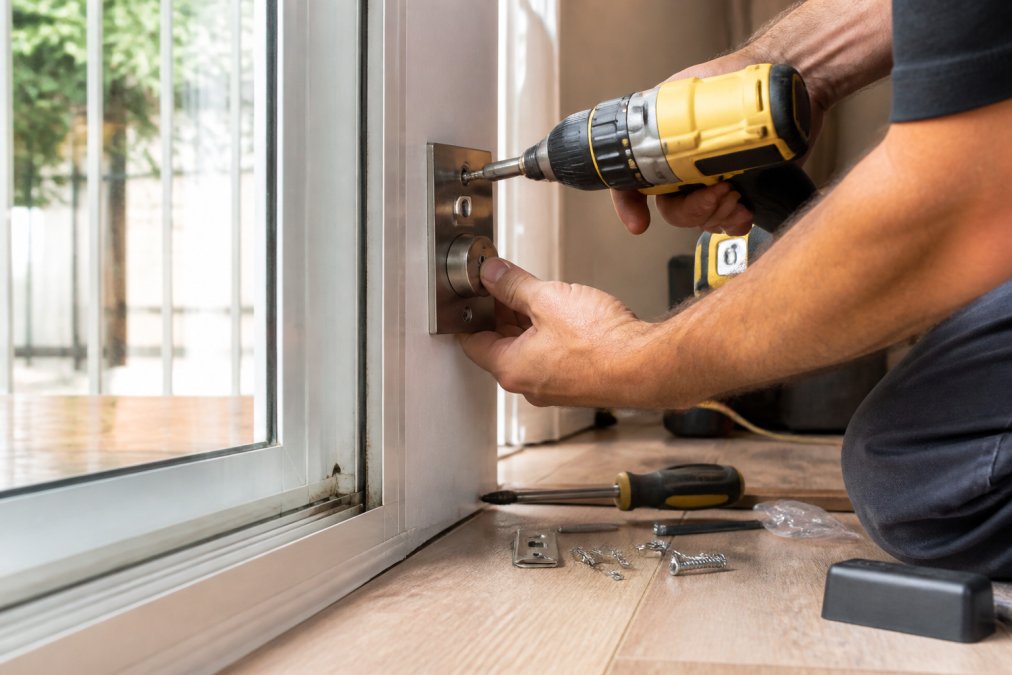
A sliding door deadbolt bolts the door panel into the frame, giving you the strongest hold of any single upgrade. Most kits install with basic tools.
Dual-Point Locking and Bolt Installation
Dual-point locking uses two lock points instead of one. This spreads the force across the door, so a single hard push won’t pop it open.
Here is how to install a deadbolt:
- Pick a spot on the frame above or below the main latch.
- Mark the hole with a pencil.
- Drill a pilot hole through the frame.
- Mount the bolt bracket with the screws provided.
- Test the bolt to make sure it seats fully.
- Add a second bolt for dual-point locking.
Do not drill through the glass or the track. A hole in the wrong spot can crack the panel or jam the door. Measure twice, drill once.
Shatterproof Security Film and Impact Resistance
Shatterproof security film is a clear layer applied to the glass that holds the pane together if it breaks. It adds impact resistance and slows anyone trying to smash through.
Rental-Friendly Upgrades and Visual Deterrents
Renters can secure a sliding door without drilling or permanent changes. Most rental-friendly upgrades install in minutes and come right off when you move. This is the section most guides skip, because they assume you own the door and can drill into it. You do not have to.
Try these:
- A cut-to-fit security bar in the track. Measure the track opening with the door closed, cut a hardwood dowel or a purpose-made bar about 1/16 inch short, and drop it in. No tools beyond a saw.
- A track lock that clamps on with no screws. Look for one with a rubber-padded jaw so it does not mar the track finish.
- A dowel or rod cut to the door width. This is the cheapest option and works on any door with a bottom track.
- Peel-and-place security film. Cut to size, spray the glass with the slip solution, squeegee out the bubbles, and trim the edges. It comes off with a heat gun or a hair dryer on low.
- A door pin or top-of-track block held in place with removable adhesive putty. This is a lighter-duty anti-lift fix for renters who cannot drive screws.
The goal is not to make your door unbreakable. It is to make it harder than the next one. Most intruders move on when a door looks like trouble.
Conclusion: Balancing Security and Egress
Every upgrade on this list has to pass one test: can you still get out fast in an emergency? A security bar that jams the door shut is a hazard, not a fix.
Frequently Asked Questions
How do I fix a sliding door that won’t lock properly?
Start by checking the strike plate alignment. If the door sags or the track is dirty, the lock mechanism won’t reach the keeper. Clean the track, adjust the roller height, and tighten the strike plate screws. If the lock still fails, the internal mechanism may be worn and need replacement. For stubborn repairs or damaged hardware, a professional can restore proper function quickly.
Are security bars for sliding doors actually effective?
Yes, when installed correctly. A security bar or track lock prevents the door from sliding open, even if the primary lock is bypassed. Look for stainless steel bars that fit snugly in the track. Anti-lift devices also stop the door from being lifted out of its frame. These mechanical locks add a critical second layer of defense against forced entry.
Should I install a keyed lock on my sliding glass door?
A keyed lock can improve security, but it may violate fire codes if it prevents egress. In an emergency, you need to exit without a key. Instead, use a dual-point locking system or a tamper-resistant track lock. These secure the door from the outside while allowing quick exit from the inside. Always prioritize safety alongside security.
What is a dual-point strike plate and how does it improve security?
A dual-point strike plate secures the door at two points instead of one, making it much harder to pry open. It replaces the standard single-point keeper and reinforces the door jamb. This hardware is tamper-resistant and works with your existing lock. A professional can ensure perfect alignment for maximum protection.