
Table of Contents
- How to Tell If Your Sliding Door Seal Is Bad
- Sliding Glass Door Seal Replacement Benefits: Energy Efficiency and Comfort
- Sliding Glass Door Weather Stripping Replacement: Materials That Perform
- Sliding Door Energy Efficiency Improvements That Cut Utility Bills
- Security and Noise Reduction: The Overlooked Benefits of New Seals
- DIY vs. Professional Seal Replacement: A Cost-Benefit Analysis
- Hurricane Protection and Wind Mitigation Insurance Discounts
- Frequently Asked Questions
Last Updated: September 26, 2026
How to Tell If Your Sliding Door Seal Is Bad
A failing sliding door seal rarely announces itself. It shows up as a door that sticks in humid weather, a faint whistle near the jamb, or a utility bill that creeps up without explanation. In South Florida, where air conditioning runs nearly year-round, a worn seal means money leaking out every month. This guide from Smooth Sliders covers how to inspect your door, what replacement fixes, and when a repair beats a full door swap.
Common warning signs include:
- Visible cracks, flattening, or gaps in the weatherstripping
- Daylight visible around the door frame
- Condensation or water trails on the interior track after rain
- A door that rattles or shifts when locked
- Rising cooling costs with no other explanation
The Step-by-Step Seal Inspection Checklist
- Test the perimeter. Use the dollar-bill method at six points: top center, both top corners, bottom center, both bottom corners, and the latch side.
- Inspect the weatherstripping visually. Look for compression, cracking, or sections that have pulled away from the frame.
- Check the bottom sweep. This is the first seal to fail because it contacts the track every time the door moves.
- Examine the track for debris and alignment. Grit accelerates seal wear; a misaligned panel grinds the seal down on one side.
- Look for water staining. Discoloration on the interior floor or sill points to water infiltration past the seal.
- Test the latch. A latch that no longer engages firmly often means the door has shifted, which stresses every seal.
- Note the door’s age. Seals on doors older than roughly a decade are usually due regardless of appearance.
A common mistake is replacing only the bottom sweep because it looks the worst. The perimeter seal and the latch seal work as a system. If one is compressed, the others are usually close behind, and replacing them together costs far less than a second service call.
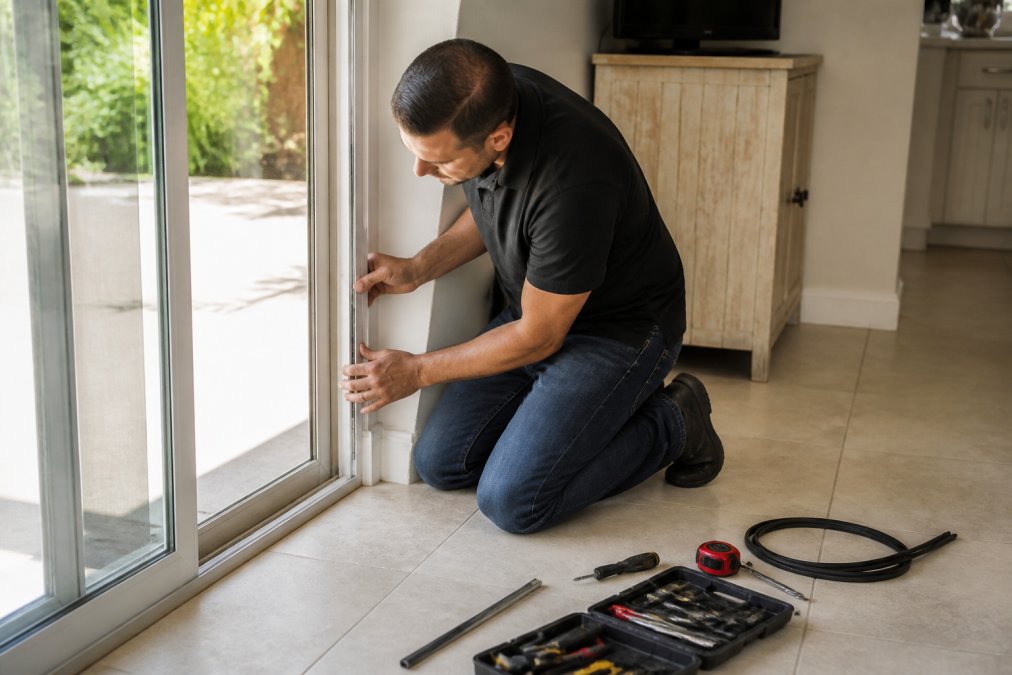
Sliding Glass Door Seal Replacement Benefits: Energy Efficiency and Comfort
The clearest benefit of seal replacement is measurable comfort. Compromised weatherstripping lets conditioned air escape and humid outside air enter, so the air conditioner works harder to hold the same temperature. New seals restore the barrier that keeps your home cool and dry.
How Seals Stop Air Infiltration and Water Leakage
Air infiltration is outside air moving through gaps around a closed door. Water leakage is the same problem with rain: water driven against the door finds the same gaps and travels inward. Both are controlled by continuous weatherstripping, a single unbroken seal running the full perimeter rather than patches at the worst spots.
Sliding Glass Door Weather Stripping Replacement: Materials That Perform
Material choice determines how long a replacement seal lasts. The wrong material for your exposure fails early, which is why a generic strip from a hardware bin often underperforms a purpose-matched product.
| Material | Best For | Durability | Notes |
|---|---|---|---|
| Vinyl | Interior, mild climates | Moderate | Affordable, stiffens with heat |
| Felt | Low-traffic interior doors | Short | Poor moisture resistance |
| Silicone | High heat, humid climates | Long | Stays flexible, resists UV |
| EPDM rubber | Exterior, storm exposure | Long | Good compression recovery |
| Brush | Track and bottom gaps | Moderate | Handles debris well |
Material matters more than brand. A silicone or EPDM seal installed correctly will outlast a premium vinyl strip every time in a hot, humid climate.
Sliding Door Energy Efficiency Improvements That Cut Utility Bills
Seal replacement is one of the cheapest energy efficiency improvements available because it targets the largest source of loss: air leakage. Pairing new seals with other upgrades compounds the effect, but only if you understand which upgrade is doing the work.
Why Air Leakage Costs More Than You Think
A sliding door is a large opening, typically six to eight feet wide and nearly seven feet tall, and the single biggest penetration in most exterior walls. When the perimeter seal fails, the door stops behaving like a wall and starts behaving like a permanently open window. Conditioned air escapes at the top and bottom of the panel, and outside air is drawn in to replace it.
The Environmental Angle Most Guides Skip
Every kilowatt-hour of cooling you avoid is one that does not have to be generated, and in most U.S. grids that generation carries a carbon cost. A door with a failed seal forces the air conditioner to run longer and harder, consuming more electricity and producing more emissions, month after month. Replacing a worn seal is a small repair with a disproportionately long tail of avoided energy use, and it stacks with every other efficiency upgrade rather than competing with them.
Which Upgrades Actually Compound
The biggest gains come from addressing the whole door, not just the seal:
- Low-E glass coatings reduce heat transfer through the glass itself by reflecting radiant heat back toward its source. On a hot day, that means less solar heat entering the home; on a cold night, less interior heat radiating out.
- Proper track alignment keeps the door seated against the seal instead of riding off it. A panel that has drifted out of square will chew through a new seal in a single season.
- A firm latch holds the panel tight against the weatherstripping. A loose latch lets the panel rock, which opens micro-gaps along the entire perimeter.
- Clean, level tracks prevent the panel from lifting and breaking the seal as it rolls.
- Argon-filled double glazing slows conductive heat transfer through the glass, complementing the reflective work low-E does.
Seal replacement is the cheapest efficiency upgrade you can make, and it is the one that makes every other upgrade work. Fix the envelope first, then improve the glass.
Security and Noise Reduction: The Overlooked Benefits of New Seals
Two benefits get almost no attention: security and quiet. A worn seal lets the panel sit loose in the frame, so the latch and any multi-point locking system cannot seat properly. A door that will not lock firmly is a security problem, not just an inconvenience.
How a Failed Seal Weakens Your Lock
A sliding door lock is a compression system. The latch, keeper, and any secondary locking points engage only when the panel is held tight against the jamb. When weatherstripping compresses or pulls away, the panel gains play, often a quarter inch or more, and that play is exactly the gap an intruder exploits.
Material Choice Changes How Much Noise You Block
Noise reduction follows the same logic as security: air gaps transmit sound. A continuous seal blocks the path, so street traffic, pool noise, and neighbor activity stay outside. But not every material performs the same way against sound.
- Silicone stays flexible and maintains contact pressure across temperature swings, which keeps the acoustic seal continuous. It is the strongest choice for noise reduction in sun-exposed doors.
- EPDM rubber offers good compression recovery and blocks airborne sound well, though it can harden slightly over many years of UV exposure.
- Vinyl is the weakest performer for noise because it stiffens with heat and loses contact pressure, opening the very gaps that let sound through.
- Brush seals handle debris well at the track but do little for airborne noise because they do not form an airtight barrier.
A Quick Diagnostic You Can Run Today
Stand inside with the door closed and the room quiet. Have someone outside speak at normal volume near the perimeter. If you hear them clearly through the edges rather than the glass, your seal is transmitting sound, and air the same way. Confirm with the dollar-bill test at the same points; if the bill slides out freely at the top or bottom corners, the barrier has already failed.
If you are replacing seals specifically for noise, choose silicone over vinyl and make sure the bottom sweep contacts the track along its full length. The bottom gap is the largest single path for both sound and air.
DIY vs. Professional Seal Replacement: A Cost-Benefit Analysis
DIY makes sense when:
- The failure is isolated to the bottom sweep or a single visible strip
- The door slides smoothly and the latch engages firmly
- The track is clean and the panel sits square in the frame
Professional service makes sense when:
- The door sticks, drags, or has jumped the track
- The latch or lock no longer engages
- Multiple seals are failing at once
- The door is impact-rated glass, which requires careful handling
Replacing seals on a door with a bent track or seized roller wastes the new parts. The panel will grind the fresh seal down within a season, and you will be back where you started with less money. Fix alignment first.
For South Florida homeowners, Smooth Sliders offers free estimates and mobile service, so diagnosis happens at your door rather than over the phone. With over 19 years of experience and a family-owned operation, the team handles track, roller, and lock repairs alongside seal work.
Hurricane Protection and Wind Mitigation Insurance Discounts
In storm-exposed regions, the seal is part of the building envelope that resists wind-driven rain. A door that leaks under pressure can let water into the home during a storm, a risk separate from the glass rating.
Frequently Asked Questions
How do I know if my sliding door seals need replacing?
Look for visible cracks, gaps, or flattened weatherstripping along the door frame. Test for drafts by holding a lit candle or a piece of tissue near the edges on a windy day. If it flickers or moves, air is getting through. You may also notice higher utility bills, condensation between the glass panes, or water pooling on the track after rain. Any of these signs means the seal has degraded and needs attention.
Can sliding glass doors be resealed without a full replacement?
Yes. In most cases, the door panel and frame are still structurally sound, and only the weatherstripping, latch seal, or silicone sealant has worn out. A professional can replace the seal without removing the entire door. This costs significantly less than a full door replacement and restores energy efficiency, security, and smooth operation. A technician can confirm whether resealing is enough or if the door frame integrity has been compromised.
What is the best type of weatherstripping for a sliding glass door?
The best material depends on your door and climate. Vinyl or felt weatherstripping works for interior tracks and low-traffic doors. For exterior sliding glass doors exposed to sun, rain, and humidity, silicone or EPDM rubber holds up longer and resists moisture damage. A continuous piece of weatherstripping along the entire track and frame edge provides the best seal against air infiltration and water leakage. A professional can recommend the right material for your specific door.
How does weatherstripping affect energy bills?
A worn seal lets conditioned air escape and outside air enter, forcing your HVAC system to work harder to maintain a comfortable temperature. Replacing the weatherstripping closes those gaps and reduces air infiltration. Homeowners often see lower utility bills and more consistent indoor temperatures after a seal replacement. The exact savings depend on your home size, climate, and how much air was leaking before the repair.
A failing seal is easy to ignore until the utility bill or a sticky door forces the issue. Smooth Sliders restores sliding glass doors with professional track, roller, and lock repairs backed by over 19 years of experience, a 100% customer satisfaction guarantee, and free estimates. Get started with Smooth Sliders and get a door that seals, locks, and slides the way it should.