
Commercial glass doors can be manual sliding doors, hinged storefront entrances or powered systems. This guide helps property managers describe a problem and arrange the right specialist. Smooth Sliders serves South Florida homes and businesses; call 954-818-9607 or request a free estimate to confirm whether your door fits our service scope. Scheduling depends on availability and parts.
Table of Contents
- When to Attempt DIY vs. Professional Commercial Glass Door Repair
- Diagnosing Common Commercial Glass Door Problems
- Understanding Commercial Door Closer Adjustment
- Commercial Storefront Door Repair Cost Factors
- Storefront Door Maintenance Checklist for Long-Term Performance
- Safety and Compliance Standards for Commercial Glass Doors
- How to Get Professional Help Fast
- Frequently Asked Questions
Last Updated: September 24, 2026
When to Attempt DIY vs. Professional Commercial Glass Door Repair
Deciding whether to handle a commercial glass door repair yourself or call a professional comes down to understanding what you’re dealing with and what risks you’re willing to take. The line between a quick fix and a job that requires expertise is clearer than most property managers realize.
Minor adjustments you can handle yourself involve simple maintenance tasks that don’t compromise safety or structural integrity. Staff can remove loose debris from accessible tracks and record changes in movement or locking. Follow the manufacturer’s care instructions. Hardware tightening, roller adjustments and lubrication are not universal DIY fixes; inappropriate changes can affect operation.
Signs you need a professional immediately include anything involving broken tempered glass, misaligned frames, or security hardware failures. Tempered glass fractures are not a DIY repair, the glass is engineered to break in a specific way for safety, and attempting to replace it yourself can result in injury. Security lock failures also demand professional attention because a malfunctioning lock compromises building access control. Door closers that aren’t functioning properly, damaged pivot hinges, or structural alignment issues all require the expertise of someone trained in commercial door systems.
The cost difference between a small repair and emergency replacement often hinges on whether you caught the problem early. A sticking door that’s ignored for weeks can develop alignment issues that become exponentially more expensive.
If you’re unsure whether something is a DIY fix or a professional job, err on the side of calling in a professional for the initial diagnosis. Many repair companies offer free estimates, so there’s no cost to finding out what you’re actually dealing with.
Diagnosing Common Commercial Glass Door Problems
Identifying what’s actually wrong with your commercial glass door is the first step toward fixing it. Most problems fall into a few recognizable categories, and understanding the symptoms helps you explain the issue clearly to a repair technician.
Sticking or dragging doors are among the most common complaints. When a door doesn’t glide smoothly, the culprit is usually a dirty or misaligned track. Debris accumulation, dirt, dust, leaves, creates friction that makes the door harder to operate. Misalignment happens when the door frame settles or when hinges loosen over time. The fix depends on the root cause. Cleaning the track often solves the problem immediately. If cleaning doesn’t help, the issue is likely alignment, which requires professional adjustment to ensure the door hangs properly and operates safely.
Broken locks and security hardware represent a security risk that can’t be ignored. A lock that won’t engage means your building isn’t secure. This includes panic bars that don’t function, magnetic locks that fail, or key cylinders that are damaged. These components are critical for commercial compliance and tenant safety. Attempting to repair security hardware yourself can create liability issues and may violate building code requirements. A professional can assess whether the hardware needs repair or replacement and ensure it meets current safety standards.
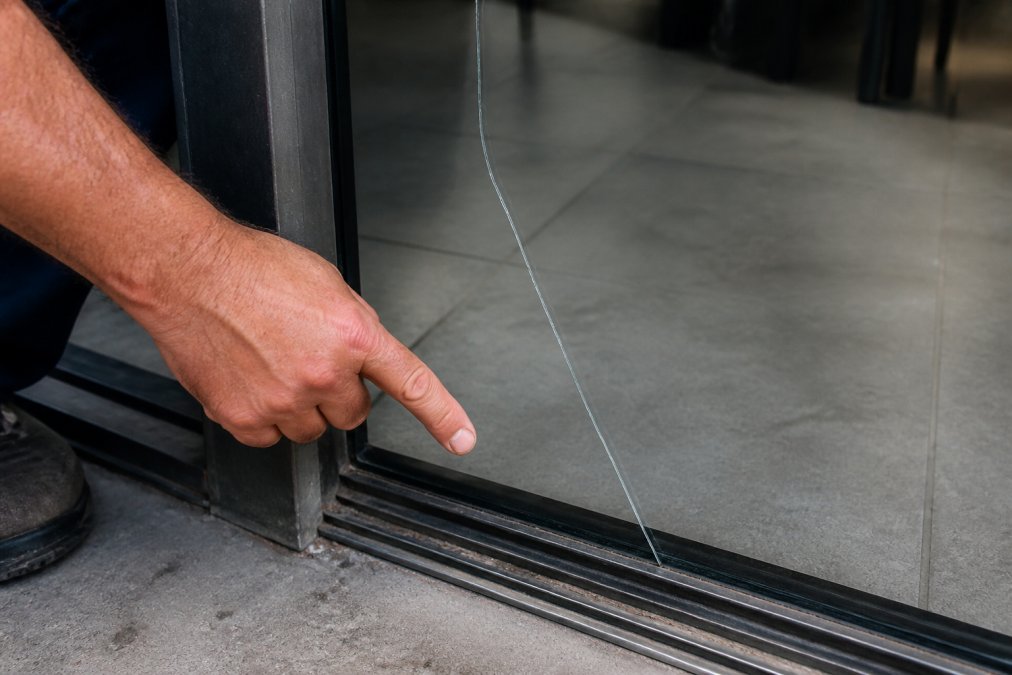
Cracked or damaged tempered glass requires immediate professional attention. Broken safety glass can cause injury. Do not patch cracked glazing, press on it or attempt to remove it yourself. The entire pane must be replaced with safety glazing that meets commercial standards. Laminated glass, which is sometimes used in commercial storefronts for added security, also requires professional replacement because it’s bonded to the frame in ways that DIY removal can damage.
Understanding Commercial Door Closer Adjustment
A door closer is the hydraulic mechanism that controls how fast a door closes and how smoothly it operates. Proper adjustment is essential for both safety and accessibility. A door that closes too quickly can injure someone. A door that closes too slowly defeats its purpose of maintaining climate control and security.
Closer, pivot, automatic-operator and security-hardware work requires a specialist familiar with the specific assembly. A general repair video does not establish the correct procedure for your door.
How door closers affect operation and safety comes down to three adjustable settings: closing speed, latching speed, and opening force. Closing speed controls how quickly the door moves from fully open to nearly closed. Latching speed controls the final motion as the door reaches the frame. Opening force determines how much strength is needed to pull the door open. Each setting must balance convenience with safety. For commercial spaces with high traffic, the door closer prevents the door from slamming while still closing completely. For accessible entrances, the opening force must comply with the Americans with Disabilities Act, which specifies maximum force requirements.
Door closer adjustment is model-specific. A trained technician should identify the closer, follow its manufacturer’s instructions and check the complete door operation afterward. Do not use a universal screw-turning direction or remove adjustment valves. A slamming door, leaking closer or entrance that will not close and latch needs professional assessment.
Attempting to adjust a door closer without understanding the mechanism can result in doors that don’t close properly or become difficult to open, creating accessibility and security issues. If you’re not familiar with door closer mechanics, contact a professional.
Commercial Storefront Door Repair Cost Factors
Understanding what influences repair pricing helps you make informed decisions about whether to repair or replace a commercial glass door. Several factors determine the final cost, and knowing them helps you get accurate estimates.
What influences repair pricing starts with the nature of the damage. A simple track cleaning costs less than replacing a broken panic bar, which costs less than replacing an entire glass pane. The type of glass matters significantly, standard tempered glass is less expensive than impact-resistant or laminated glass. The complexity of the repair affects labor time. Labor time depends on the assembly, condition and access; an inspection is needed before estimating duration. The availability of replacement parts also influences cost. Common hardware is usually in stock and can be replaced quickly. Specialized commercial hardware might need to be ordered, adding to the timeline and potentially increasing costs.
Repair vs. replacement decisions depend on the age of the door system and the extent of damage. If your commercial glass door is relatively new and the damage is isolated to one component, a broken lock, a single cracked pane, or a malfunctioning closer, repair is usually the right choice. If the door system is aging and you’re facing multiple failures, replacement might be more cost-effective long-term.
Most commercial glass door repairs cost significantly less than replacement, but the right choice depends on the age of the system and whether damage is isolated or part of a pattern of failures.
Storefront Door Maintenance Checklist for Long-Term Performance
Preventative maintenance extends the life of your commercial glass door and prevents expensive emergency repairs. A consistent maintenance schedule catches small problems before they become big ones.
| Task | Frequency | Time Required | What to Check |
|---|---|---|---|
| Visual inspection | Monthly | 5 minutes | Glass cracks, frame alignment, hardware function |
| Track cleaning | Monthly | 10 minutes | Debris removal, smooth operation |
| Lock testing | Monthly | 3 minutes | Security hardware engagement, key operation |
| Professional inspection | Twice yearly | 30-45 minutes | Alignment, wear patterns, seal integrity |
| Lubrication | Twice yearly | 20 minutes | Manufacturer-approved points only; no blanket lubrication of closers, locks or sealed bearings |
| Weather seal check | Seasonally | 10 minutes | Caulking condition, air leaks, water infiltration |
Safety and Compliance Standards for Commercial Glass Doors
Commercial glass doors must meet specific safety and accessibility standards. Understanding these requirements protects your building, your occupants, and your liability.
How to Get Professional Help Fast
When you need commercial glass door repair, knowing how to find and communicate with a professional service makes the process faster and more efficient.
Frequently Asked Questions
What are the most common signs that a commercial glass door needs professional repair?
Common signs include difficulty opening or closing, visible cracks or chips in tempered glass, broken locks or panic bars, misaligned frames, and excessive air leakage around the door seal. If you notice the door dragging, making unusual sounds, or failing to latch securely, these indicate structural or hardware issues that require professional assessment. Addressing these early prevents security risks and energy loss.
How much does commercial glass door repair typically cost?
Repair costs depend on the type of damage, whether it’s glass replacement, hardware repair, or door closer adjustment, and the complexity of the storefront configuration. Minor adjustments cost less than full glass replacement or structural repairs. For an accurate estimate specific to your commercial glass door repair needs, contact a local service provider for a free inspection. Pricing varies based on materials, labor, and emergency service timing.
Can I fix a commercial glass door myself, or do I need a professional?
Removing loose track debris and recording symptoms may be appropriate; hardware adjustments should follow manufacturer guidance and the technician’s assessment. However, commercial glass door repair involving tempered glass, structural damage, security locks, or door closers should always be handled by professionals. Tempered glass is safety-rated and must meet building codes; improper repair creates liability and security risks. Professional technicians have the tools, training, and insurance to ensure compliance and proper function.
What should be included in a storefront door maintenance checklist to prevent repairs?
Monthly tasks include cleaning tracks of debris, checking that locks function smoothly, inspecting glass for cracks, and ensuring the door opens and closes without dragging. Arrange professional checks of seals, alignment and hardware at intervals appropriate to the assembly and usage. Follow the manufacturer’s lubrication instructions. For commercial properties, document all maintenance and inspections for compliance records. Regular preventative maintenance extends door life, maintains energy efficiency, and reduces emergency repair costs.
Commercial glass door repair doesn’t have to be complicated or expensive when you address problems early and work with professionals who understand commercial systems. Regular maintenance prevents most emergencies, and knowing when to call a professional protects both your building and your budget. Contact Smooth Sliders for a free estimate and discover how professional repair can restore your commercial glass doors to reliable operation while keeping your property secure and energy-efficient.