
Table of Contents
- Signs of Worn Out Pocket Door Hardware
- Best Tools for Pocket Door Maintenance
- How to Access the Roller Assembly Without Removing Trim
- Pocket Door Roller Adjustment: Raise, Lower, and Level the Panel
- Troubleshooting Stuck, Dragging, or Crooked Pocket Doors
- How to Remove the Door from the Track for Deep Repairs
- Aligning the Door with the Strike Plate and Latch
- When to Repair vs. Replace Pocket Door Hardware
- Frequently Asked Questions
Last Updated: September 13, 2026
Signs of Worn Out Pocket Door Hardware
A pocket door that scrapes the frame or refuses to latch usually has failing hardware, not a ruined door. Catching it early is the difference between a quick pocket door alignment fix and a full replacement.
Most problems trace back to three wear points: the roller assembly, the hanger bolts, and the track. When any degrade, the panel sags, tilts, or drags.
Here’s what to watch for before the damage compounds:
- Scraping or grinding noise as the door slides, caused by rollers flattening against the track
- A visible gap or tilt at the top of the door when it’s closed
- The door drifts open or won’t stay put, a sign the track has gone out of level
- Sticking halfway through travel, which points to a bent track or a binding roller
- A loose or wobbly panel that rocks when you push it, meaning the hanger bolts have backed out
Ignoring a dragging door is the most common mistake homeowners make. Continued friction wears a groove into the track, and a grooved track can’t be adjusted back to level. What starts as a five-minute pocket door roller adjustment becomes a track replacement.
The good news: worn hardware is almost always repairable. According to This Old House’s guide to pocket door repair, most sticking and dragging issues come down to adjustment rather than structural failure.
Best Tools for Pocket Door Maintenance
Most pocket door alignment jobs are won or lost by whether you have the right wrench. The cavity between the door panel and the jamb is only about 1/2 inch to 3/4 inch wide, which rules out a standard open-end wrench and most adjustable wrenches (thisoldhouse.com). That constraint drives the entire tool list.
The essential set:
- Offset wrench set (the make-or-break tool). The offset head turns a hanger bolt flush against the jamb without the handle binding on the door face. Look for 7/16 in., 1/2 in., and 9/16 in., those sizes fit most residential pocket door kits sold in the last 30 years. A stubby offset wrench (5 to 6 inches) gives more swing room.
- Ratchet-style offset wrench or a low-profile bit driver. On newer kits with hex-head adjustment screws instead of nuts, a 1/4 in. hex driver on a short bit holder reaches the screw head without marring the jamb.
- Screwdriver set (Phillips and flathead). For guide hardware, strike plates, and door stops. A stubby flathead is worth having for the same tight-clearance reason as the offset wrench.
- 24-inch spirit level. Long enough to read plumb on a standard 80-inch door panel, short enough to fit inside the pocket cavity (homedepot.com). A torpedo level is too short to catch a subtle tilt across the full panel height.
- Silicone spray lubricant (dry-film type). Coats the track and roller races without a wet film. Avoid oil-based products and grease, they attract drywall dust and sawdust and turn into a gum that binds the carriage.
- Flashlight or headlamp. The roller assembly sits in shadow even in a well-lit room. A headlamp keeps both hands free while you hold the wrench.
- Painter’s tape and a utility knife. Tape protects the casing if you remove a door stop; the knife scores a painted-shut seam so trim releases cleanly instead of tearing paint.
| Tool | Purpose | Why It Matters |
|---|---|---|
| Offset wrench (7/16, 1/2, 9/16 in.) | Turn hanger bolts | Only wrench geometry that fits the 1/2-3/4 in. cavity |
| Stubby screwdriver set | Adjust guides and stops | Reaches fasteners the full-size driver can’t |
| 24-inch spirit level | Check plumb and level | Catches tilt a torpedo level misses |
| Dry-film silicone spray | Lubricate track and rollers | Won’t collect dust the way oil does |
| Headlamp | Illuminate the cavity | Keeps both hands free at the wrench |
| Painter’s tape + utility knife | Protect trim during access | Prevents paint tear-out on painted-shut stops |
Before you buy anything, slide the door open and shine a light into the gap at the top of the panel. Note whether the hanger bolt takes a hex nut or a hex-head screw, and measure the nut across the flats with a small adjustable wrench. Buying the single correct offset size beats buying a set you’ll never fully use.
Don’t substitute pliers or a crescent wrench for the offset wrench. The jaws round off the hanger bolt nut, and a rounded nut is the single most common reason a DIY pocket door adjustment turns into a hardware replacement.
How to Access the Roller Assembly Without Removing Trim
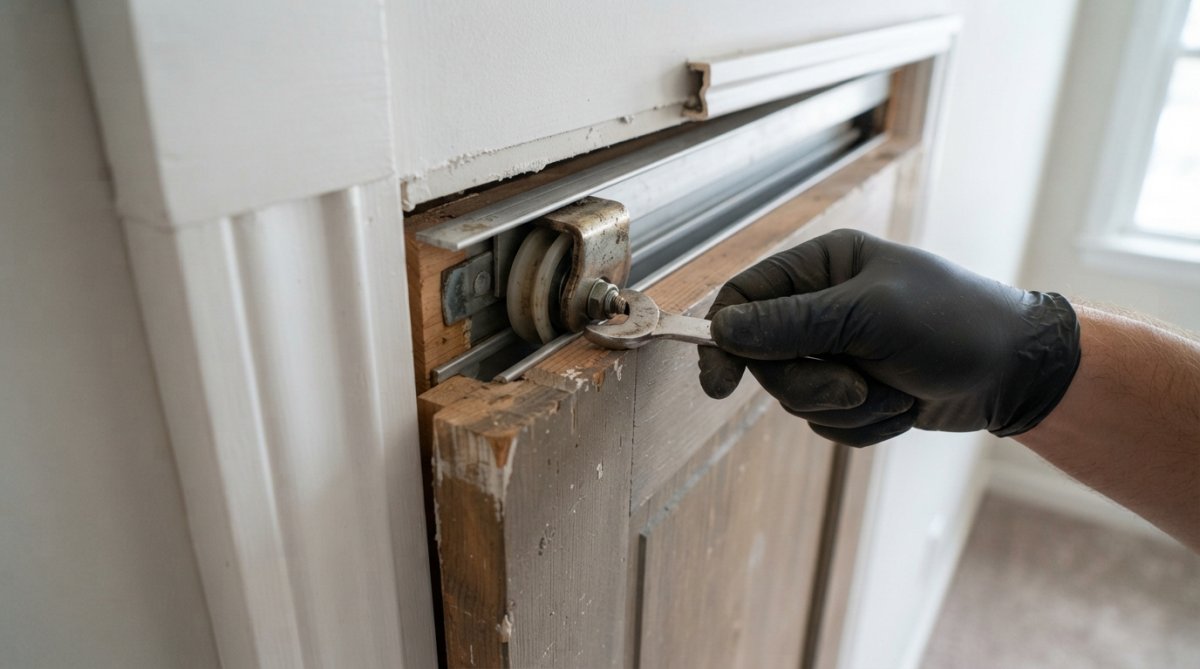
You can reach the roller assembly on most pocket doors without pulling trim. The trick is working through the gap at the top of the door rather than dismantling the wall.
Here’s the no-trim-removal method:
- Slide the door open about halfway so the top rollers sit near the access opening.
- Look for a small access panel or a removable stop on the jamb side. Many modern pocket door kits include one.
- If there’s no panel, slide the door until the hanger bolt aligns with the widest part of the track opening.
- Insert your offset wrench into the gap and locate the adjustment screw on the hanger bolt.
- Make your adjustment in small quarter-turns, then test the door’s travel.
Older installations without an access panel may require removing the door stop, a single piece of trim, not the full casing. If the header or casing is painted shut, score the paint line with a utility knife before prying.
Pocket Door Roller Adjustment: Raise, Lower, and Level the Panel
Pocket door roller adjustment is the core of fixing alignment. The hanger bolts at the top of the door control height and tilt; a few turns in the right direction solves most sagging or dragging.
To raise the door: Turn the adjustment screw clockwise. This lifts the panel and increases clearance at the floor.
To lower the door: Turn the adjustment screw counterclockwise. This closes a gap at the top or stops the door from rubbing the header.
To level a tilted panel: Adjust the front and rear hanger bolts independently. If the leading edge sags, raise that side. If the trailing edge drags, raise the other.
Work in small increments and check with your spirit level after each turn. A quarter-turn often moves the panel more than you expect.
The panel should hang plumb with even clearance on both sides and roughly a finger’s width of gap at the floor. If you can’t reach that with the hanger bolts alone, the track itself is out of level and needs attention first.
Troubleshooting Stuck, Dragging, or Crooked Pocket Doors
A stuck or dragging pocket door almost always has one of four causes: a misaligned track, a worn roller, a binding guide, or debris in the cavity. The harder question is whether the hardware is still adjustable or worn past the point where turning a hanger bolt helps, that decision separates a 20-minute fix from a hardware replacement.
Match the symptom to the fix, and to the wear threshold:
- Door drags along the bottom. The floor guide is misaligned or the panel sits too low. Raise the hanger bolts slightly. If the door still drags after you’ve raised it to the top of its adjustment range, the rollers have flattened and need replacement, not more turning.
- Door sticks at one spot. The track is bent or has debris. Clean the track and check for a kink by running a straightedge along the top flange. A kink you can feel with a fingernail is a track replacement, not an adjustment.
- Door is crooked when closed. The hanger bolts are uneven. Level the panel front to rear. If the panel won’t hold level after you tighten the lock nut, the hanger bolt threads are stripped.
- Door won’t move at all. A roller has jumped the track or seized. You’ll likely need to remove the door. Before you do, check whether the roller wheel still spins freely by hand, a wheel that wobbles on its axle or has a flat spot is done.
- Door rattles in the frame. The guide or strike plate is loose. Tighten the fasteners; if the screw holes are wallowed out, step up to the next screw size rather than over-tightening.
The wear test that tells you repair vs. replace:
Before committing to an adjustment, run this three-point check. It takes two minutes and tells you whether you’re fixing the door or wasting an afternoon.
- Spin test. With the door open, spin each roller wheel by hand. It should turn smoothly with no wobble or grinding. A wheel that feels gritty, wobbles on its axle, or has a flat spot is worn out, adjustment won’t restore it.
- Track test. Run your finger along the inside of the track where the rollers ride. A healthy track feels smooth. A groove you can catch a fingernail in, or a visible dip, means the track has worn through its finish and the rollers will keep finding that low spot no matter how you adjust them.
- Thread test. Loosen the hanger bolt lock nut and turn the adjustment screw a half-turn each way. If it turns freely and the door moves, the threads are good. If it spins without moving the door or feels gritty, the threads are stripped.
If all three pass, adjust. If any one fails, plan on replacing that component, and if two or more fail, replace the whole carriage and track as a set. Mixing new rollers with a grooved track just wears the new rollers into the same groove.
A common pattern is a door that’s been dragging for months. By the time the homeowner notices, the roller has usually worn a groove into the track. At that point the hanger bolt adjustment is a temporary fix at best, the door will drift back into the groove within weeks. Replacing the track and carriage together is the durable repair.
A common mistake is reaching for the hammer when a door binds. Force bends the track and turns a simple adjustment into a replacement. If the door resists, stop and run the three-point wear test.
How to Remove the Door from the Track for Deep Repairs
When adjustment can’t solve the problem, you’ll need to lift the door off the track, a two-person job on most solid-core doors.
Steps to remove the panel:
- Slide the door fully open to expose the hanger bolts.
- Use your offset wrench to loosen the adjustment screw on each hanger bolt, lowering the door slightly.
- Tilt the bottom of the door outward while lifting the top to disengage the rollers from the track.
- With a helper, lift the panel clear and set it aside on padding.
- Inspect the rollers, track, and carriage for wear, bends, or debris.
Once the door is out, clean the track, replace worn rollers, and check that the carriage runs smoothly before reinstalling.
Aligning the Door with the Strike Plate and Latch
A door that slides smoothly but won’t latch has a strike plate alignment problem, not a track problem. The latch and strike plate must line up horizontally and vertically.
Check these points:
- Vertical alignment, if the latch sits above or below the strike plate opening, adjust the hanger bolts to raise or lower the panel.
- Horizontal alignment, if the latch is too far in or out, the strike plate may need to shift, or the door stop needs adjusting.
- Depth, if the latch enters but doesn’t catch, the strike plate is set too deep. A shim behind it brings the catch into range.
Confirm the door is plumb with your level before touching the strike plate. Adjusting the plate to compensate for a crooked door just hides the real problem.
When to Repair vs. Replace Pocket Door Hardware
Repair is the right call in most cases; replacement is reserved for specific failures. Knowing the difference saves money and unnecessary work.
Repair when:
- The rollers are worn but the track is intact
- The hanger bolts are loose but not stripped
- The door drags but the panel is structurally sound
- Alignment is off but the hardware is otherwise functional
Replace when:
- The track is bent, grooved, or cracked
- The carriage or hanger bolts are stripped or broken
- The hardware is corroded beyond cleaning
- Multiple components have failed at once
For homeowners who’d rather not tackle a stuck or heavy panel, professional repair is often a good solution. Smooth Sliders has handled sliding and pocket door repairs across South Florida for over 19 years, with mobile service and free estimates. Same-day service is available for urgent issues like a door that won’t lock.
Frequently Asked Questions
Can you adjust a pocket door without removing the trim?
Yes, most pocket doors can be adjusted without removing trim. Look for an access panel or a small gap at the top of the door jamb. If your door has a removable head casing, you can often reach the hanger bolts with a stubby screwdriver or offset wrench. For hidden adjustments, check the manufacturer’s instructions; some systems have adjustment screws accessible from the side of the door panel.
How do I fix a misaligned pocket door that is rubbing against the frame?
First, check if the door is plumb and level. If it’s rubbing, the roller height may be uneven. Use an offset wrench to turn the adjustment screw on the roller assembly. Raise the side that’s dragging. If the door is still binding, inspect the track for debris or bends. Lubricate the track with silicone spray. If the problem persists, the roller may be worn and need replacement.
What are the signs of worn out pocket door hardware?
Common signs include the door dragging on the floor, difficulty sliding, a wobbling panel, visible cracks or flat spots on rollers, and a sagging door that won’t stay level. You might also hear scraping or grinding noises. If the door jumps off the track or the hanger bolts won’t hold adjustment, the hardware is likely worn out and should be replaced.
How do you adjust the height of a pocket door?
To adjust height, locate the hanger bolts on the top of the door panel. Turn the adjustment screw clockwise to raise the door and counterclockwise to lower it. Make small quarter-turn adjustments, then test the door’s movement. Ensure the door clears the floor by about 1/8 inch and is level. If one side is higher, adjust each roller independently until the door is plumb.
A pocket door that won’t align is a security and convenience problem, especially when the latch won’t catch. Most alignment issues come down to a few turns of a hanger bolt, but a stuck, heavy, or damaged door is worth handing to a professional. Smooth Sliders brings over 19 years of experience, mobile service that comes to you, same-day availability, and free estimates to every job. Get a free estimate from Smooth Sliders and restore smooth, secure pocket door operation.