
Table of Contents
- Why Your Sliding Door Won’t Lock Properly
- Best Tools for Sliding Door Repair
- Step-by-Step Sliding Door Lock Repair
- Sliding Glass Door Lock Replacement Cost
- Sliding Door Security Upgrades
- When to Call a Professional for Sliding Door Lock Repair
- Frequently Asked Questions
Last Updated: September 11, 2026
Why Your Sliding Door Won’t Lock Properly
A sliding door won’t lock properly repair job usually starts with one of four culprits: a misaligned frame, a dirty or dry latch mechanism, loose mounting screws, or a broken internal spring. Diagnosing which one you’re dealing with takes about five minutes and saves you from replacing parts that were never the problem.
This guide walks through the full diagnostic and repair sequence for sliding door locks in South Florida, where salt air and humidity can accelerate corrosion on tracks and fasteners (nasa.gov). Below, we’ll show you how to identify your lock type, fix common failures, and know when a repair stops being a weekend project. The repair scenarios we cover account for many common lock failures on sliding glass doors, pocket doors, and closet doors.
Here’s the part most guides skip: the lock is rarely the actual failure point. The door has usually dropped on its rollers or drifted out of plumb, and the latch simply can’t reach the keeper plate anymore. Fix the alignment first, and a surprising number of “broken” locks start working again.
Common Causes of Lock Failure
Misalignment is the single most common cause of a sliding door that won’t latch (homedepot.com). When the door sags on worn rollers or the frame shifts, the hook latch and keeper plate no longer meet at the same height, so the lock engages partially or not at all.
Other frequent causes:
- Loose mounting screws in the handle assembly or faceplate, letting the latch move under pressure
- A dry or corroded latch mechanism that binds before the bolt fully extends
- A broken internal spring inside the mortise lock or hook latch
- Debris in the track that stops the door short of the locking point
- Worn weather stripping that changes how far the door panel travels
How to Diagnose the Problem
Close the door and watch the latch as it meets the keeper. If the latch passes above or below the keeper opening, you have an alignment problem. If it lines up but won’t engage, the issue is inside the mechanism.
Next, check these three things:
- Push the door panel toward the frame while turning the lock. If it catches, the door is drifting.
- Inspect the track for debris, flattened rollers, or a bent rail.
- Wiggle the handle assembly. Any movement means loose fasteners.
Best Tools for Sliding Door Repair
The best tools for sliding door repair depend on which lock family you’re working on. Before you buy anything, identify your lock type, that single step determines which tools and parts you actually need. Most guides skip it, which is why so many homeowners end up with a replacement latch that doesn’t fit.
Identify Your Lock Type First
Sliding door locks fall into three common families. Knowing which one you have tells you what tools to grab and what part to order.
- Hook latch (surface-mounted): A curved hook on the door edge that swings into a keeper on the jamb. Common on builder-grade vinyl and aluminum sliders. Usually held by two or three Phillips screws on the faceplate.
- Mortise lock (flush-mounted): A rectangular lock body set into a mortise cut into the door stile, with a separate handle and actuator. Common on older wood and some impact-rated sliders. Requires removing the handle and faceplate to access.
- Keyed handle assembly with integrated actuator: The lock cylinder and latch are one unit built into the handle. Common on newer impact glass and patio sliders. Replacement usually means swapping the whole handle set, not just the latch.
If you can’t tell which you have, take a photo of the door edge with the lock engaged and a photo of the faceplate straight-on. Those two images are enough to match a part at most hardware suppliers.
Tools by Task
For diagnosis:
- Flashlight, the latch pocket and keeper are shadowed; you’ll miss debris and wear without one
- Feeler gauges or a business card, checks the gap between the door edge and the jamb to confirm alignment before you touch the lock
- Tape measure, records backset and faceplate dimensions before you order any part
For disassembly and adjustment:
- #2 Phillips and a small flathead screwdriver, faceplate, handle, and keeper screws
- Putty knife, pries a stuck faceplate without marring the door stile
- Shop vacuum or stiff brush, clears track debris and the latch pocket
- Silicone-based lubricant, safe for most latch mechanisms; oil-based products attract grit and make binding worse (dap.com)
- Replacement fasteners, stainless steel screws resist corrosion better than the zinc-plated factory screws, especially in humid or coastal climates
For measuring a replacement part (the step most guides skip):
- Tape measure or calipers, you need the backset (distance from the door edge to the center of the latch or cylinder) and the faceplate height and width
- A phone camera, photograph the old lock next to a ruler so you can compare dimensions against a listing before you buy
Keep a magnet handy when you remove latch screws. Sliding door frames are narrow, and a dropped screw almost always lands in the track where it jams the roller later.
Don’t buy a replacement lock until you’ve measured backset and faceplate. A latch that’s 1/8 inch off on backset will not seat, and that’s the most common reason a DIY lock swap fails.
Step-by-Step Sliding Door Lock Repair
The repair sequence below runs from simplest to most involved. Stop as soon as the lock engages cleanly; you don’t need to complete every step.
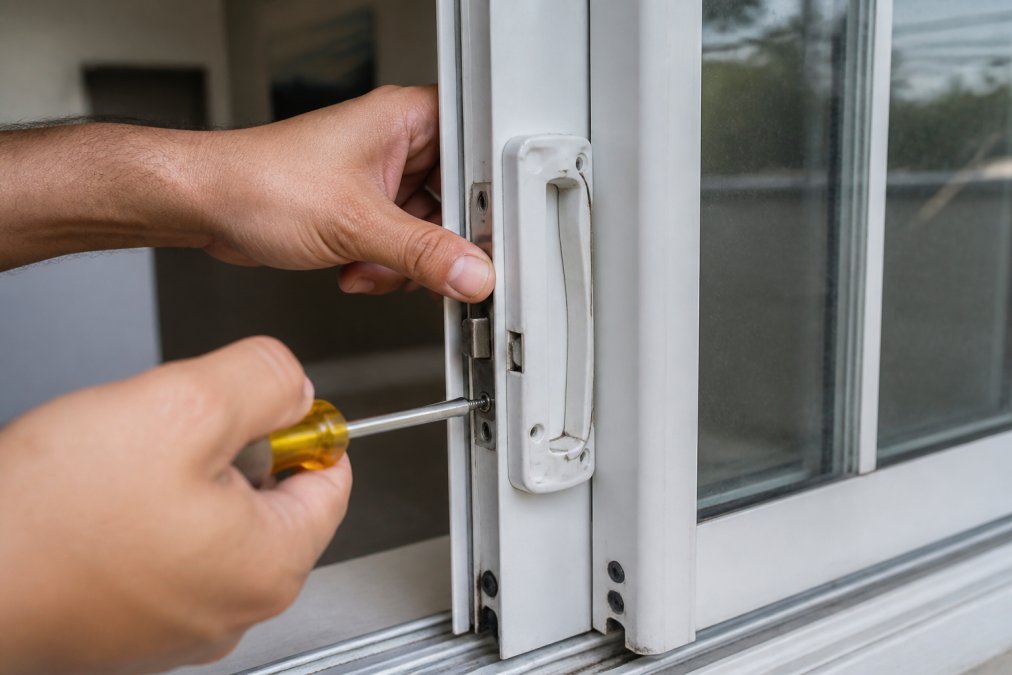
Tightening Loose Mounting Screws
Loose mounting screws are the fastest fix and the one most homeowners overlook. Tighten every screw on the handle assembly, faceplate, and keeper plate before touching anything else.
Use a screwdriver, not a drill, on the final turn. Over-torquing strips the screw holes in aluminum frames, and a stripped hole means the latch will never sit firmly again. If a screw spins freely, step up to the next gauge or fill the hole with a wooden toothpick and wood glue before re-driving.
Adjusting Door Alignment and Rollers
Roller adjustment corrects the vertical position of the door panel. Most sliding doors have an adjustment screw on the bottom roller, accessible through a small slot in the frame or by removing the bottom trim.
Turn the adjustment screw clockwise to raise the door and counterclockwise to lower it. Make quarter-turn adjustments and test the lock after each one. The goal is a door that sits level in the frame with the latch meeting the keeper at the same height. If the door binds against the frame after adjustment, you’ve raised it too far.
Cleaning and Lubricating the Latch Mechanism
Cleaning the latch pocket and keeper removes the grit that causes binding. Vacuum the pocket, wipe the keeper plate with a damp cloth, and let both dry completely before lubricating.
Apply a silicone-based lubricant to the latch, the keeper, and the track rollers. Work the lock open and closed several times to distribute it. Reapply every few months in coastal environments, where salt air speeds up corrosion on metal components.
Replacing a Broken Internal Spring or Hook Latch
A broken internal spring shows up as a latch that flops loosely or won’t retract. On most sliding doors, you’ll replace the entire hook latch or mortise lock rather than the spring alone, since springs aren’t sold separately for most models.
Remove the faceplate screws, slide the old latch out of the mortise, and match it against your replacement. Pay attention to the backset (the distance from the door edge to the center of the latch) and the faceplate dimensions. A mismatched backset is the number one reason a replacement latch won’t seat correctly.
Never force a latch into a mortise that’s too small. You’ll crack the door stile, and a cracked stile on a glass door panel usually means replacing the whole panel rather than the lock.
Sliding Glass Door Lock Replacement Cost
Sliding glass door lock replacement cost depends on three things: the lock type, whether the door needs realignment, and whether the replacement part is a stock item or a specialty match. Because pricing varies by model and door configuration, Smooth Sliders provides free estimates.
What Drives the Number
- Lock type: a basic surface-mounted hook latch is the least expensive to replace. A keyed mortise lock or a handle assembly with an integrated actuator costs more because the part itself is more complex and often requires removing the handle set to access.
- Part availability: discontinued or builder-grade hardware can take longer to source. If the manufacturer no longer makes the part, a universal replacement may need minor modification to the mortise or faceplate.
- Alignment work: if rollers or the track need repair alongside the lock, that adds labor. Alignment is often the real fix, the lock was never the problem.
- Door type: impact glass and pocket doors often use different hardware than standard sliders. Pocket door hardware is buried inside the wall cavity, which adds access time.
How to Source the Right Replacement Part
This is the step most guides skip, and it’s the one that determines whether your repair succeeds on the first try.
- Measure the backset. With the lock removed, measure from the edge of the door to the center of the latch or cylinder. Common backsets are 2-3/8 inches and 2-3/4 inches on residential doors, but sliding doors vary, measure yours, don’t assume.
- Measure the faceplate. Record the height and width of the faceplate and the screw hole spacing. A faceplate that’s slightly too large won’t sit flush, and one that’s too small leaves gaps that let the latch shift.
- Note the lock family. Hook latch, mortise lock, or integrated handle assembly. Parts are not interchangeable between families.
- Photograph the old part next to a ruler. Most online suppliers and hardware counters can match a part from a clear photo with dimensions visible.
- Check the door manufacturer. If the door is a known brand, the manufacturer or its parts distributor may still stock the exact lock. That’s the fastest path to a correct fit.
Never force a latch into a mortise that’s too small. You’ll crack the door stile, and a cracked stile on a glass door panel usually means replacing the whole panel rather than the lock.
When a Repair Beats a Replacement
If the lock body is intact and only the spring, latch, or alignment is off, a repair is almost always the better path. Replacement makes sense when the lock body is cracked, the cylinder is seized, or the part is discontinued and no compatible substitute exists. In those cases, a universal replacement lock or a secondary locking device may be the practical answer.
For current pricing on your specific door, check the Smooth Sliders pricing page or request a free estimate.
Sliding Door Security Upgrades
Sliding door security upgrades address the fact that a standard hook latch is a weak locking point. The latch holds the door to the frame, but it doesn’t stop the panel from being lifted off the track.
Practical upgrades worth considering:
- Secondary locks: a pin or bar lock adds a second locking point and stops track-lift attacks
- Track blocks or anti-lift devices: physically prevent the door from being lifted out of the track
- Security film on glass: holds shattered glass together on impact, which matters on older non-impact panels
- Reinforced strike plates: longer screws into the frame studs resist forced entry better than short factory screws
If your door won’t lock at all, treat it as a security risk first and a convenience problem second. A door that closes but doesn’t latch is an open door with extra steps.
When to Call a Professional for Sliding Door Lock Repair
Call a professional when the door needs realignment beyond roller adjustment, when the lock is a discontinued model you can’t source, or when the repair involves impact glass or pocket door hardware. Those jobs carry a real risk of damaging the panel or the frame.
Signs it’s time to hand it off:
- The door panel is cracked, fogged, or has failed seals
- You’ve adjusted the rollers and the latch still misses the keeper
- The mortise is stripped or the frame is bent
- The door is a pocket door with hardware buried inside the wall cavity
At Smooth Sliders, we’ve handled these repairs across South Florida for over 19 years, with mobile service that comes to your door and same-day availability for urgent lock failures. Our team works on sliding glass doors, pocket doors, closet doors, and impact windows, and we offer free estimates so you know the scope before anyone picks up a screwdriver. If your HOA needs proof of insurance and references before approving a vendor, we can provide those upfront.
Frequently Asked Questions
Why is my sliding glass door not locking?
The most common reason a sliding glass door won’t lock is misalignment between the latch and the keeper plate, often caused by worn rollers or a shifted door panel. Other causes include a broken internal spring, loose mounting screws, or debris in the track. Start by checking if the door sits level, then inspect the latch and keeper for damage. If the hook latch doesn’t catch, adjustment or part replacement is usually needed.
Can I replace a sliding door lock myself?
Yes, many sliding door lock repairs are DIY-friendly. You can tighten mounting screws, clean and lubricate the latch mechanism, and adjust door alignment with basic tools. Replacing a mortise lock or hook latch requires matching the backset and faceplate dimensions, which you can find by removing the old lock and measuring. If the door frame is damaged or the lock is integrated with impact glass, call a professional.
How much does sliding glass door lock replacement cost?
Costs vary based on the lock type, door material, and whether professional labor is needed. A basic hook latch or mortise lock replacement is relatively affordable, while integrated impact-glass locks cost more. For an accurate quote, check Smooth Sliders’ website or request a free estimate. Smooth Sliders offers mobile service and free estimates.
Is it safe to use WD-40 on sliding door locking mechanisms?
WD-40 can temporarily free up a sticky lock, but it attracts dust and dirt over time, which can worsen binding. For long-term results, use a silicone-based lubricant on the latch, keeper, and track. Apply sparingly and wipe away excess. If the lock still won’t engage after cleaning and lubricating, the internal spring or actuator may be worn and need replacement.
A door that won’t lock is a security problem, not just an inconvenience, and it rarely fixes itself as hardware wears further. Smooth Sliders brings over 19 years of sliding door and window repair experience directly to your property, with same-day service, mobile repairs, and a 100% customer satisfaction guarantee. Get a free estimate from Smooth Sliders and get your door locking properly again.