
Table of Contents
- Why Your Sliding Door Is Sticking
- Tools You’ll Need for Sliding Door Repair
- How to Clean Sliding Door Tracks
- The Best Lubricant for Sliding Door Tracks
- How to Adjust Sliding Door Rollers for Proper Alignment
- Sliding Glass Door Roller Replacement: When and How
- Troubleshooting Other Causes of a Sticking Sliding Door
- When to Call a Professional for Sticking Sliding Door Repair
- Frequently Asked Questions
Last Updated: September 6, 2026
Why Your Sliding Door Is Sticking
A sticking sliding door is rarely a single point of failure. The root cause usually sits in one of three places: a dirty bottom track, worn-out rollers, or a door panel that has shifted out of alignment. Understanding which one you are dealing with determines whether the fix takes five minutes with a vacuum or requires replacing hardware.
Most homeowners in South Florida face this issue because of sand and salt residue that builds up in the track channel. That grit acts like sandpaper between the wheel assembly and the track, creating friction that makes the door feel heavy and difficult to move.
At Smooth Sliders, we have spent over 19 years diagnosing exactly these problems across Miami-Dade, Broward, and Palm Beach counties. The good news is that most sticking sliding door issues are fixable without a full replacement, and many respond to basic maintenance you can do in an afternoon. A sticking sliding door is a symptom of accumulated debris, worn rollers, or misalignment, and each cause has a specific remedy.
Below, we will walk through the complete process from cleaning to roller replacement, including the tools you need and the common mistakes that turn a simple repair into a costly service call.
Tools You’ll Need for Sliding Door Repair
Before you start, gather the right equipment. Improvising with the wrong tools is a common reason DIY repairs fail or damage the door panel.
| Tool | Purpose | Alternative |
|---|---|---|
| Vacuum with crevice attachment | Remove loose debris from track | Stiff brush or compressed air |
| Stiff scrub brush or old toothbrush | Loosen caked-on grime | Small putty knife wrapped in cloth |
| Mild detergent and warm water | Break down grease and salt residue | White vinegar diluted with water |
| Flathead screwdriver | Adjust roller height screws | Phillips screwdriver for some models |
| Silicone spray or dry lubricant | Reduce friction on moving parts | Graphite powder for interior tracks |
| Rubber mallet | Gently tap the door panel back into alignment | Block of wood and hammer |
| Flashlight | Inspect the track and rollers clearly | Phone light |
A common mistake is using a wet lubricant like WD-40 on the tracks. It attracts dust and sand, which recreates the exact friction problem you are trying to solve. For sliding glass door maintenance, you want a product that dries without leaving a sticky residue.
If you are missing the adjustment screw access, check the end of the door panel. Most sliding doors have small caps that pop off to reveal the roller adjustment mechanism.
How to Clean Sliding Door Tracks
Cleaning the track is the first and most important step in fixing a sticking sliding door. A clean track solves roughly half of all sticking issues because debris is the most common cause of friction (hud.gov).
Start by removing the sliding door panel if possible. This gives you full access to the bottom track and makes the job significantly easier. If you cannot remove the panel, slide it fully open to expose as much of the track as possible.
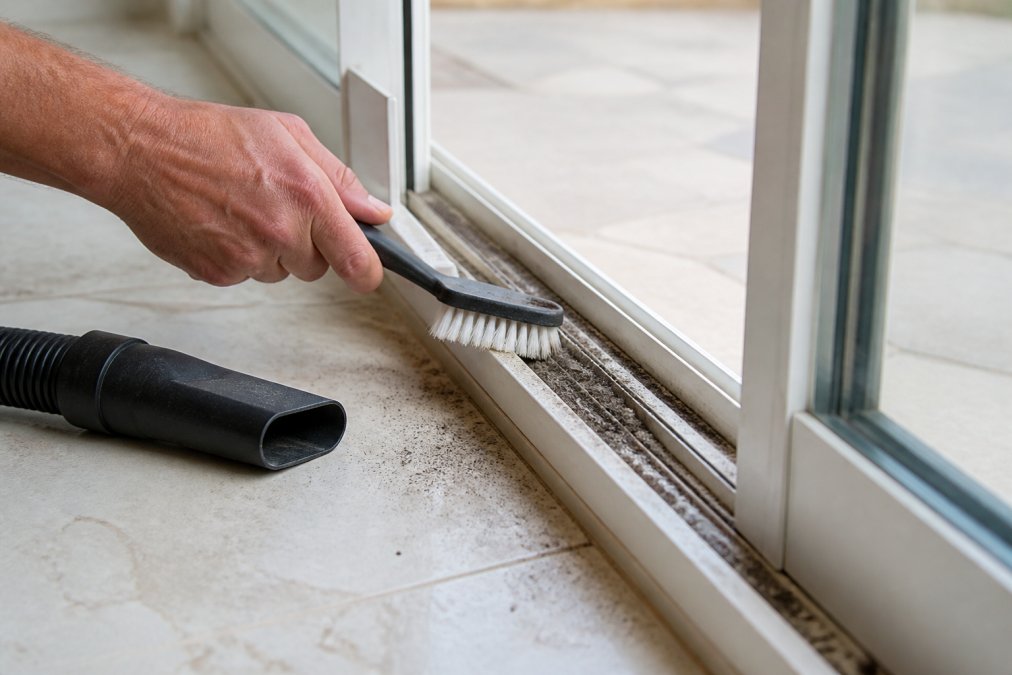
Follow these steps to clean the track thoroughly:
- Vacuum the entire track channel to remove loose sand, dust, and small debris
- Spray the track with mild detergent mixed with warm water and let it sit for two minutes
- Scrub the track with a stiff brush, paying extra attention to the corners where grit accumulates
- Wipe the track dry with a clean cloth, then vacuum again to remove any loosened residue
- Inspect the track for dents or obstructions that could catch the rollers
The bottom track is the primary culprit in most sticking cases, but do not ignore the top track. The top track guides the door and can accumulate dust that causes the door to tilt and drag.
Do not use a metal scraper or sharp tool to remove stubborn debris from the track (aluminum.org). Aluminum tracks scratch easily, and those scratches create rough surfaces that will damage your rollers over time.
The Best Lubricant for Sliding Door Tracks
After cleaning, lubrication is the step that restores smooth operation. The best lubricant for sliding door tracks is a silicone-based spray or a dry Teflon lubricant, because both reduce friction without attracting dust.
Silicone spray is the most versatile option for sliding glass doors. It adheres to the track and rollers, provides lasting protection against moisture, and does not gum up over time. Apply it sparingly: one light coat across the bottom track and the roller wheels is usually sufficient.
Dry lubricants, such as graphite powder, work well for interior doors where dust accumulation is a concern. They leave no wet residue, which makes them ideal for pocket doors and closet doors that see frequent use.
Avoid these common mistakes when lubricating:
- Do not use WD-40 or oil-based products, which attract dirt and dry into a sticky film
- Do not overspray, as excess lubricant drips onto the floor and creates a slip hazard
- Do not lubricate a dirty track, as you will simply seal the grit into the moving parts
Apply the lubricant, then slide the door back and forth several times to distribute it evenly. Wipe away any excess with a clean cloth.
For best results, clean and lubricate your sliding door tracks twice a year (energy.gov). In coastal areas, sand and salt accelerate wear, so quarterly maintenance is a smarter schedule for smooth operation and longer roller life.
How to Adjust Sliding Door Rollers for Proper Alignment
If cleaning and lubrication do not solve the sticking problem, the rollers likely need adjustment. Sliding door rollers sit in a wheel assembly at the bottom corners of the door panel, and they control both the height and the alignment of the door.
A sticking sliding door often means the rollers have worn unevenly or the door has sagged on its track. Adjusting the rollers raises or lowers the door panel so it sits level and moves freely.
Here is how to adjust the rollers:
- Locate the adjustment screws on the bottom edge of the door panel, usually near the corners
- Use a flathead screwdriver to turn the adjustment screw clockwise to raise the door
- Turn the screw counterclockwise to lower the door panel
- Make small adjustments, no more than a quarter turn at a time
- Test the door by sliding it after each adjustment to check for smooth movement
The goal is leveling: the door panel should sit evenly on both rollers, with the bottom edge parallel to the track. If the door scrapes the floor or the frame, raise it slightly. If it wobbles or jumps the track, lower it.
Door alignment also depends on the head stop, the small bracket at the top of the frame that keeps the door from swinging inward. If the door is sticking at the top, the head stop may need adjustment to create proper clearance.
Proper roller adjustment resolves most sticking issues that persist after cleaning. The door should glide with minimal effort, and you should not need to force it at any point along the track.
Sliding Glass Door Roller Replacement: When and How
Roller replacement is necessary when the wheels are cracked, flat-spotted, or worn down to the point where adjustment cannot compensate. This is a common outcome for doors that have been sticking for months, because forcing the door grinds the rollers against debris.
How do you know it is time for a sliding glass door roller replacement? Look for these signs:
- The door is difficult to lift or feels like it is dragging on the track
- You can see visible wear, cracks, or flat spots on the wheels
- The door has been adjusted to maximum height but still rubs against the frame
- You hear a grinding or scraping sound when sliding the door
Replacing rollers requires removing the door panel from the track. This is a two-person job for most sliding glass doors, as the panels are heavy and fragile.
The replacement process follows these steps:
- Remove the door panel by lifting it up into the top track and tilting the bottom outward
- Lay the panel on a soft surface with the bottom edge facing up
- Remove the screws holding the wheel assembly in place
- Slide the old roller assembly out and replace it with a matching new one
- Reinstall the panel by reversing the removal process
Sliding glass door panels are heavy and can cause serious injury or shatter if dropped. If you are not confident handling the panel, do not attempt this repair alone. A cracked impact glass panel is an expensive mistake.
Roller replacement is where many DIY attempts go wrong, because door manufacturers use different roller sizes and mounting styles. Ordering the wrong part is common, and forcing an incompatible roller into the assembly can damage the door frame.
Troubleshooting Other Causes of a Sticking Sliding Door
When cleaning, lubrication, and roller work do not solve the problem, other factors are at play. A sticking sliding door can also trace back to the frame, the weatherstripping, or the track itself.
Work through this troubleshooting checklist to identify the remaining cause:
- Check the track for dents or bends. A damaged track needs replacement, not repair
- Inspect the weatherstripping along the frame. Worn or swollen weatherstripping creates drag that makes the door hard to slide
- Look at the door frame for signs of warping, especially in older homes or after hurricane season
- Verify that the door panel is square. A dropped or damaged panel may no longer fit the frame properly
- Examine the top track for obstructions that could catch the top rollers
Track obstruction is more common than most homeowners realize. Small stones, broken glass, or hardware screws can lodge in the track channel and block the rollers completely.
Weatherstripping impact is another factor that gets overlooked. When weatherstripping compresses or shifts, it presses against the door panel and increases friction. Replacing worn weatherstripping restores smooth operation and improves energy efficiency by sealing the gap around the door.
If you have gone through all these steps and the door still sticks, the issue may be structural. In South Florida, homes shift and settle, which can pull the door frame out of square. A frame that is no longer level will cause the door to bind regardless of the condition of the rollers or track.
When to Call a Professional for Sticking Sliding Door Repair
Some sticking sliding door problems require professional diagnosis and repair. If you have cleaned the tracks, lubricated the rollers, and adjusted the alignment without success, the issue likely involves damaged hardware or a misaligned frame that needs specialized tools.
Calling a professional makes sense when you encounter any of these situations:
- The door panel is cracked, chipped, or showing signs of impact damage
- The rollers are seized and will not turn even after cleaning and lubrication
- The track is bent or damaged and requires replacement
- The door frame is out of square and needs adjustment
- You are not comfortable removing and handling the heavy door panel
At Smooth Sliders, our team handles these exact repairs daily. We provide mobile service across South Florida, meaning we come to your location with the right parts and tools rather than asking you to bring the door to us. With over 19 years of experience, we have seen every variation of sticking door, from single-family homes to condo complexes with strict HOA requirements.
Professional repair offers benefits beyond fixing the immediate problem. A correctly aligned and lubricated door reduces strain on the rollers and track, extending the life of your hardware. It also improves the seal around the door, which keeps out heat and humidity and helps lower energy costs during the summer months.
If your door will not lock properly or you are concerned about security, do not wait. A door that sticks is often a door that does not latch correctly, leaving your home vulnerable.
A sticking sliding door is one of the most common and most fixable home maintenance issues. Start with a thorough track cleaning, apply the right lubricant, and adjust the rollers to restore smooth operation. When those steps do not work, roller replacement or professional diagnosis is the next move.
For homeowners and businesses in South Florida, Smooth Sliders offers fast, reliable repair with free estimates and same-day service. Whether you need a roller replacement, track repair, or a full door alignment, our family-owned team brings 19 years of experience directly to your door. Get A Free Estimate and restore your sliding door to smooth, secure operation.
Frequently Asked Questions
What is the best lubricant for sliding door tracks?
A dry lubricant, such as a silicone spray or a product specifically made for sliding door tracks, is best. Dry lubricants don’t attract dust and dirt like oil or grease, which can quickly make the sticking problem worse. Apply a light coat to the track and the top of the rollers after cleaning. Avoid using WD-40 as a long-term solution, as it can gum up the track over time.
How do you fix a sliding door that will not slide smoothly?
Start by cleaning the bottom track thoroughly to remove any debris that could be blocking the wheels. After cleaning, check the adjustment screws on the bottom of the door panel; turning them can raise or lower the door to align it with the track. Finally, apply a dry lubricant to the track. If the door still sticks, the rollers may be worn out and need replacing.
Can you replace sliding door rollers yourself?
Yes, replacing the rollers is a manageable DIY project for many homeowners. You’ll need a screwdriver and possibly pliers. First, remove the door by lifting it up and tilting the bottom out. Then, locate the roller assembly at the bottom corners of the door panel, remove the screws, and install the new roller. It’s a good idea to clean the track while the door is off.
When should you call a professional for sliding door repair?
If you’ve cleaned the track, adjusted the rollers, and applied lubricant but the door is still sticking, or if the door feels unusually heavy, is off its track, or has broken glass, it’s time to call a professional. A specialist can diagnose issues with the door frame, weatherstripping, or alignment that aren’t visible or safe to fix on your own.