Table of Contents
- Why Sliding Doors Drain Energy in South Florida Homes
- Sliding Glass Door Weatherstripping Replacement: When and How
- How to Seal Sliding Glass Doors for Winter and Summer
- Sliding Door Roller Repair Benefits for Energy Efficiency
- Glass, Frames, and Glazing: Choosing Energy-Efficient Upgrades
- Smart Home Integration and Climate-Specific Strategies for 2026
- Retrofitting vs. Full Replacement: ROI and Sustainability
- Conclusion: Your 2026 Sliding Door Energy Action Plan
- Frequently Asked Questions
Last Updated: October 4, 2026
Why Sliding Doors Drain Energy in South Florida Homes
A sliding glass door is the largest moving glass panel in most homes, and that size works against you in a cooling-dominated climate.
Air infiltration is the uncontrolled movement of outside air through gaps around a door frame, and it is the single biggest reason a sliding door feels like an open window. Heat transfer works alongside it. In a cooling climate, thermal energy moves from the hot, humid outside toward the cooler interior through the glass, the frame, and every unsealed joint.
How Heat Transfer and Air Infiltration Work
Three mechanisms drive the loss:
- Conduction moves heat directly through glass and metal frames.
- Convection circulates air within the gap between panes.
- Radiation transfers heat from the sun through the glass into the room.
A failed seal adds a fourth problem: air infiltration, where humid outside air pushes through worn weatherstripping and drain openings. That humid air carries a second cost in South Florida, because your AC must remove moisture as well as heat.
The Real Cost of a Leaky Sliding Door on Your AC Bill
A door with failed weatherstripping and a misaligned panel leaks continuously. The compressor cycles more, run times stretch, and the system works harder during peak afternoon hours. The U.S. Department of Energy guidance on air sealing notes that sealing air leaks is one of the most cost-effective ways to cut cooling demand in hot climates. The fix is rarely a new door.
Ignoring a dragging panel accelerates the problem. A worn roller tilts the door, which compresses and tears the weatherstripping along the bottom track. What starts as a $0 adjustment becomes a full seal replacement.
Sliding Glass Door Weatherstripping Replacement: When and How
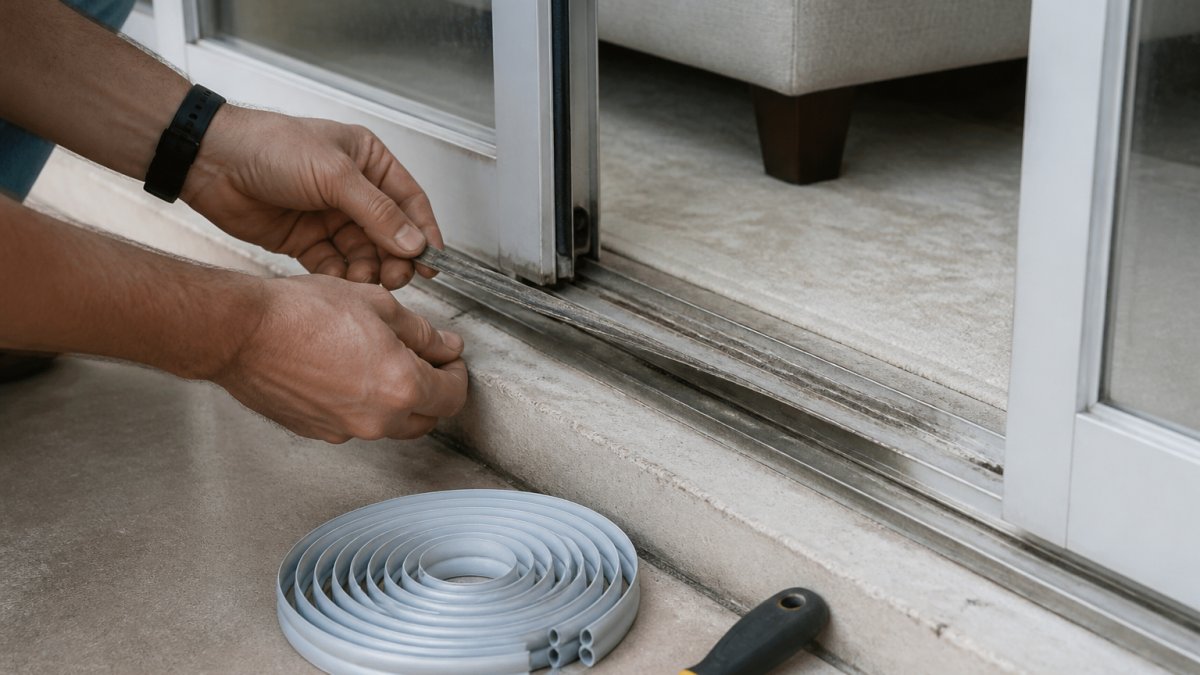
Sliding glass door weatherstripping replacement is due when you can see daylight, feel a draft, or hear outside noise through the closed door.

The Four Seal Zones on a Sliding Door
A sliding door has four seals, and each fails differently:
- Interlock (meeting stile) seal, the vertical seal where the sliding panel meets the fixed panel. This is the highest-load seal because it flexes every time the door opens.
- Perimeter jamb seal, the vertical and top seals where the panel meets the frame.
- Bottom sweep, the horizontal seal that rides on the sill and blocks air and water at the track.
Weatherstripping Materials and Where Each Belongs
| Material | Best Use | Trade-off |
|---|---|---|
| Felt | Interior jamb gaps, low-traffic doors | Cheapest, but compresses and holds moisture |
| Vinyl (V-strip or bulb) | Perimeter jamb and interlock | Good memory, degrades under UV over time |
| Foam tape | Quick fixes at corners | Short lifespan, not for moving panels |
| Silicone or EPDM | Interlock and bottom sweep | Longest life, higher cost, stiffer feel |
| Fin seal (mylar/PP) | Interlock on newer doors | Excellent seal, sensitive to track alignment |
In a hot, humid climate, silicone and EPDM outlast felt and vinyl because they resist moisture and UV better. Felt is a temporary fix at best.
Signs Your Weatherstripping Has Failed
Check for these:
- Visible cracks, flattening, or peeling along the frame
- Daylight at the corners or along the meeting stile
- A draft you can feel with your hand at the edges
DIY vs. Professional Replacement
Replacing the felt or vinyl strip along the frame is a reasonable weekend task. Replacing the interlock weatherstripping, the seal where the two panels meet, is not: it requires removing a panel, and a heavy, impact-rated, or off-track panel can be damaged during removal. If your door is hard to lift out or the track is bent, call a professional.
Replace the bottom sweep and the interlock at the same time. Doing one without the other leaves a gap at the corner where the two seals meet, which is exactly where most leaks start. Match the material to the exposure: silicone or EPDM on the exterior-facing seals, felt only on protected interior gaps.
A seal that looks intact can still be the leak. If the panel is not square in the frame, the interlock never fully compresses, and no amount of new weatherstripping will fix it until the rollers are adjusted.
How to Seal Sliding Glass Doors for Winter and Summer
Learning how to seal sliding glass doors for winter and summer comes down to sealing the full perimeter, not just the visible gaps. In South Florida, summer performance matters most, but the same checklist works year-round.
Step-by-Step Sealing Checklist
- Clean the track and remove debris that prevents full closure
- Inspect the interlock seal where the panels meet
- Replace cracked or flattened weatherstripping
| Problem | Likely Cause | Fix | Impact |
|---|---|---|---|
| Draft at bottom | Worn sweep | Replace sweep | Draft reduction |
| Daylight at corner | Failed interlock | Replace interlock seal | Stops air infiltration |
| Door drags | Worn rollers | Roller repair | Restores seal contact |
| Water pooling | Clogged weep holes | Clear drains | Prevents frame rot |
| Door won’t latch | Misalignment | Track adjustment | Full closure |
Sliding Door Roller Repair Benefits for Energy Efficiency
Sliding door roller repair benefits extend well beyond easier opening. Rollers set the panel’s height and angle; when they wear, the panel drops and tilts, breaking the seal along the bottom and the meeting stile, which is why a dragging door so often accompanies a higher cooling bill.
Thermal bridging makes this worse: a metal frame conducts heat directly between outside and inside, and any gap in the seal lets humid air bypass the glass entirely. Restoring correct roller alignment re-establishes full seal contact without replacing a single pane of glass.
Alignment is an energy fix, not just a convenience fix. A properly hung panel seals evenly on all four sides, which is what actually stops infiltration.
Glass, Frames, and Glazing: Choosing Energy-Efficient Upgrades
Glass and frame specification decide a door’s baseline performance, so understand the numbers before you spend. The U-Factor measures how fast heat moves through the assembly, and the Solar Heat Gain Coefficient (SHGC) measures how much solar heat the glass admits, lower is better for both in a cooling climate. R-value is the inverse measure of thermal insulation, so higher is better. Visible Transmittance (VT) tells you how much daylight passes through, and Air Leakage (AL) rates how much air escapes through the assembly itself.
Reading the Ratings: What to Look For
In a cooling-dominated climate, priorities flip compared with a heating climate:
- U-Factor: lower is better. Double-pane assemblies with a low-E coating and argon fill typically land in the 0.25-0.40 range; triple-pane can reach lower, but the added weight and cost rarely pay back in a mild-winter market.
- SHGC: lower is better for cooling. Look for values around 0.25 or below on west- and south-facing doors to cut afternoon solar gain.
- VT: higher means more daylight. A low SHGC with a reasonable VT lets you keep the view without the heat.
The trade-off is real: driving SHGC very low can tint the glass and reduce daylight, so specify per orientation rather than applying one number to every door.
Low-E Coatings and Argon Gas Fill Explained
A low-emissivity coating is a microscopic metallic layer applied to glass that reflects radiant heat back toward its source, blocking solar heat while still letting visible light through. Argon gas fill is a dense, inert gas sealed between panes that slows convection compared with air. Together they reduce heat transfer without darkening the room, and a warm-edge spacer further reduces conduction at the glass edge, where a surprising share of heat moves.
Frame Materials: Vinyl, Fiberglass, and Aluminum Thermal Breaks
Frame material matters as much as the glass:
- Vinyl insulates well and resists moisture, but can flex in extreme heat.
- Fiberglass holds its shape, insulates strongly, and handles humidity well.
- Aluminum is strong and slim, but conducts heat unless it has a thermal break, a non-conductive insert separating the inner and outer frame.
Climate-Specific Glazing Strategy
Most guides give one set of numbers for the whole country, but the U.S. Department of Energy maps the country into climate zones, and the right glazing spec changes by zone:
- Hot-humid zones (much of the Southeast and Gulf Coast): prioritize low SHGC and high condensation resistance. Solar control and moisture management beat winter insulation.
- Mixed and hot-dry zones: balance SHGC against winter U-Factor, since both heating and cooling loads matter.
- Cold zones: prioritize low U-Factor and higher SHGC to capture passive solar heat.
For a cooling-dominated home, specify by orientation: west- and south-facing doors get the lowest SHGC, while north-facing doors can run a higher SHGC to keep daylight without a big heat penalty.
Best for coastal homes in hot-humid zones: fiberglass or thermally broken aluminum frames with low-E, argon-filled double glazing, a warm-edge spacer, and impact-rated glass where windborne debris requirements apply. Impact assemblies use different frames and seals, so confirm ratings on the full assembly, not just the glass.
Do not buy glass by pane count alone. A well-specified double-pane unit with low-E, argon, and a warm-edge spacer can outperform a poorly specified triple-pane unit in a cooling climate, at lower weight and cost.
Smart Home Integration and Climate-Specific Strategies for 2026
Smart home integration is the angle most sliding door guides skip. A door sensor paired with your thermostat tells the system when the door is open, so the AC pauses instead of cooling the neighborhood. Automated shades respond to sun angle and cut solar heat gain during peak hours without blocking your view the rest of the day.
Climate-specific strategy matters here. This is a cooling-dominated market, so priorities differ from a heating climate:
- Prioritize solar control and moisture management over winter draft sealing.
- Choose condensation resistance ratings suited to high humidity.
- Verify impact-rated glass meets local windborne debris requirements, since impact assemblies use different frames and seals.
For code specifics, consult the Florida Building Code resources rather than relying on general advice.
Retrofitting vs. Full Replacement: ROI and Sustainability
Retrofitting wins on cost and carbon in most cases: repairing seals, rollers, and alignment restores performance at a fraction of replacement cost and keeps existing glass and frames out of the landfill.
Sustainability favors repair first. Manufacturing new glass and frames carries significant embodied carbon, so extending the life of a functioning assembly is the lower-impact choice. The U.S. Environmental Protection Agency on reducing construction waste notes that building material reuse and repair reduce landfill volume and lifecycle emissions.
Conclusion: Your 2026 Sliding Door Energy Action Plan
Start with the seal, then the alignment, then the glass. Most South Florida homes see significant gains from weatherstripping replacement and roller repair, both of which Smooth Sliders handles as a single mobile visit with free estimates and same-day service. Get a free estimate from Smooth Sliders and let our team restore a door that seals, locks, and slides the way it should.
Frequently Asked Questions
What type of sliding patio door is the most energy-efficient?
Doors with double or triple-pane glass, Low-E coatings, and argon gas fill between the panes perform best. Look for a U-Factor of 0.30 or lower and a Solar Heat Gain Coefficient under 0.25 for hot climates. Vinyl or fiberglass frames with thermal breaks outperform standard aluminum because they reduce thermal bridging. In South Florida, impact-rated sliding glass doors often combine energy efficiency with hurricane protection, making them a practical upgrade for homeowners in Miami-Dade, Broward, and Palm Beach counties.
How often should sliding door weatherstripping be replaced?
Most weatherstripping lasts 3 to 5 years in South Florida’s heat and humidity. Check it every spring for cracks, compression, or gaps around the frame. If you can see daylight through the edges or feel air moving when the door is closed, it needs replacement. Sliding glass door weatherstripping replacement is one of the cheapest ways to cut air infiltration and reduce HVAC load. A professional can inspect and replace worn seals in a single visit.
Can professional track repair improve door insulation?
Yes. When rollers are worn or the track is misaligned, the door panel sits unevenly and leaves gaps along the frame. That allows outside air to enter and conditioned air to escape. Sliding door roller repair benefits include smoother operation and a tighter seal against the weatherstripping. Fixing the alignment restores the door’s ability to block heat transfer and air infiltration, which directly reduces HVAC load and energy costs.
What can I put on my sliding glass door to keep the heat out?
Start with interior options: reflective window film, cellular shades, or solar screens can block a significant portion of radiant heat. Exterior shading like a patio cover or awning works even better because it stops heat before it reaches the glass. For a permanent fix, upgrade to Low-E coated glass with argon gas fill. Sealing gaps with fresh weatherstripping and ensuring the door closes tightly also makes a measurable difference in how much heat enters your home.
Do sliding glass doors lose a lot of heat?
They can. Older single-pane sliding doors with worn seals allow substantial heat transfer and air infiltration. The large glass area acts as a thermal weak point compared to insulated walls. In summer, that means your AC works harder to remove heat gain. In winter, warm air escapes through gaps and poorly insulated glass. Upgrading to double-pane Low-E glass, replacing weatherstripping, and repairing rollers can reduce these losses noticeably.
Is retrofitting my existing sliding door worth it compared to full replacement?
Retrofitting is usually the better value if your door frame and glass are structurally sound. Replacing weatherstripping, repairing rollers, and adding window film costs far less than a new door and delivers immediate improvements in draft reduction and energy savings. Full replacement makes sense when the glass is cracked, the frame is warped, or you want to upgrade to impact-rated Low-E glass. A professional inspection can tell you which path gives you the best return.