
Table of Contents
- When Pocket Door Repair Makes Financial Sense
- The Most Common Pocket Door Problems and What They Cost
- How to Fix Pocket Door Alignment: A Step-by-Step Guide
- Average Cost to Repair a Pocket Door in 2026
- DIY vs Professional Pocket Door Repair: Which Is Right for You?
- How Wall Construction Impacts Your Repair Options
- The Long-Term Value of Professional Pocket Door Maintenance
- Conclusion
- Frequently Asked Questions
Last Updated: September 20, 2026
When Pocket Door Repair Makes Financial Sense
Pocket door repair is worth it when the damage is limited to the hardware, not the wall. If your door is off its track, stuck, or dragging, a repair usually costs far less than a full replacement. The real question is whether the problem lives in the mechanism or the wall behind it.
The Most Common Pocket Door Problems and What They Cost
Most pocket door failures fall into two categories: the door leaves the track, or the hardware wears out. Both are mechanical and usually fixable without opening the wall.
Off-Track and Derailed Doors
An off-track pocket door has jumped its roller and is no longer supported by the track. This usually happens when the door is yanked, a stop is missing, or the rollers have worn enough to let the door drop.
Worn Rollers and Hardware Failure
Worn rollers are the number one cause of a sticking pocket door. Ball-bearing rollers last years, but cheap nylon wheels can flatten and seize within a few seasons.
Never lubricate a pocket door track with grease or oil. It attracts dust and grit, which accelerates roller wear and can gum up the track. Use a dry silicone spray instead.
How to Fix Pocket Door Alignment: A Step-by-Step Guide
Fixing pocket door alignment starts with removing the door from the wall cavity, inspecting the rollers and track, and adjusting the hanger bolts until the door hangs plumb. Most alignment issues need only a screwdriver and a level.
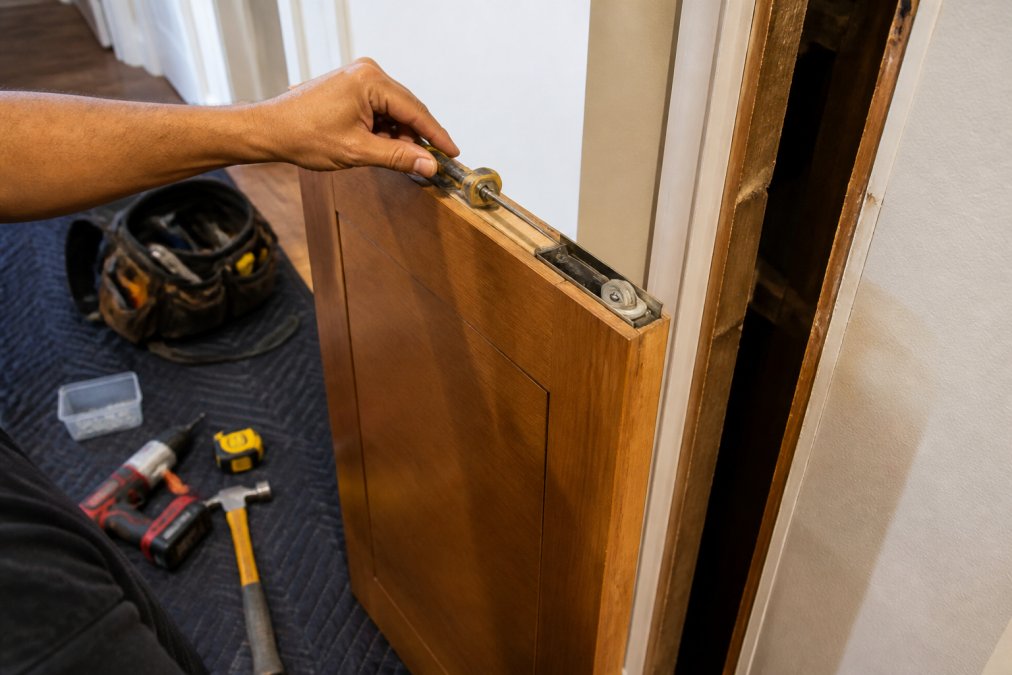
Here is the process, step by step.
- Remove the door stops and any trim blocking the pocket opening.
- Pull the door out of the wall cavity until you can reach the hanger hardware on top.
- Lift the door off the track and set it aside on a padded surface.
- Inspect the rollers for flat spots, cracks, or seized bearings. Replace any that are worn.
- Check the track for bends, debris, or loose mounting screws. Straighten or re-secure as needed.
- Re-hang the door and adjust the hanger bolts to level the panel.
- Test the slide. The door should move with light finger pressure and sit flush when closed.
Before you re-hang the door, vacuum the track and wipe it with a dry cloth. Grit left in the track is the fastest way to ruin a new set of rollers.
Average Cost to Repair a Pocket Door in 2026
Pocket door repair costs vary widely based on the problem and who does the work. A simple roller replacement sits at the low end; a repair that requires opening drywall and rebuilding the track sits at the high end. Because pricing depends on your door, your wall, and the parts needed, the only reliable number comes from an on-site estimate.
| Scope of Work | Typical Total Cost | What It Includes |
|---|---|---|
| Roller replacement only | $150 – $350 | Remove door, swap 2 rollers, re-hang, adjust |
| Roller + track hardware kit | $300 – $600 | New ball-bearing rollers, new track, hanger bolts |
| Off-track reset with trim removal | $200 – $450 | Pull trim, reset panel, replace stops |
| Track replacement requiring drywall access | $600 – $1,200 | Cut drywall, replace track, patch and paint |
| Full pocket door replacement (frame intact) | $1,200 – $2,500 | New panel, new hardware, finish work |
| Structural rebuild (rot, collapsed track, wall damage) | $2,000 – $4,500+ | Open wall, reframe pocket, new unit, full finish |
The Repair-vs-Replace Threshold
A useful rule of thumb: if the repair quote approaches the cost of a full replacement, replacement might be a more sensible option. For example, a significant track repair on a builder-grade hollow-core door might be less cost-effective than a full replacement, whereas a roller and hardware upgrade on a solid-core door can be a clear value.
Parts vs. Labor
Most homeowners are surprised by how cheap the parts are and how much of the bill is labor. The cost of parts for pocket door repairs can be relatively low. The rest of your invoice is access, removal, adjustment, and finish repair.
Parts are rarely the expensive part of a pocket door repair. Access is. If a technician can reach the hardware without opening the wall, expect a low-end bill. If the wall has to come open, expect the price to double or triple.
DIY vs Professional Pocket Door Repair: Which Is Right for You?
DIY pocket door repair works when the door is accessible and the problem is mechanical. Professional repair makes more sense when the wall must be opened, the track is damaged, or you need it done right the first time.
Ask yourself three questions:
- Can I remove the door without damaging the trim or wall?
- Are the rollers and track reachable without cutting drywall?
- Do I have a level and the patience to adjust hanger bolts until the door sits plumb?
How Wall Construction Impacts Your Repair Options
Wall construction decides whether your pocket door repair is a one-hour job or a full-day project. Most cost guides skip this angle, quoting a price without asking what the wall is made of, and the wall, not the door, sets the budget.
Drywall Pocket Walls
Drywall is the best-case scenario. The cavity is usually framed with 2×4 studs and a metal or wood track header, and the drywall is 1/2-inch or 5/8-inch gypsum board. A technician can cut a clean access panel, reach the track and rollers, make the repair, and patch with matching board, joint compound, and texture.
Plaster and Lath Walls
Plaster-and-lath walls are common in homes built before roughly 1950 and are the biggest hidden cost in pocket door repair. Plaster is brittle, cutting it cleanly is difficult, the lath behind it must be re-secured, and patching plaster to match is a skilled trade, not a Saturday DIY project.
Tiled and Stone-Faced Walls
A pocket door in a tiled bathroom or stone-faced wall is the most expensive scenario short of structural damage. Access means cutting through tile or stone, and matching the material is often impossible, tile lots vary and discontinued tile may not exist. Often the entire wall face must be re-tiled to keep the finish consistent.
Masonry and Concrete Block Walls
The rough opening in a masonry or concrete block wall is rigid. With no flex in the framing, track alignment problems that a few turns of a hanger bolt would fix in a wood-framed wall may require opening the wall and shimming or re-setting the track header.
How to Tell What You Have
Before you call for an estimate, look at the wall around the pocket door opening:
- Drywall: smooth surface, seams visible at corners, sounds hollow when tapped.
- Plaster: very hard surface, often with a slight wave, sounds solid when tapped, may have hairline cracks.
- Tile or stone: obvious from the surface.
- Masonry or block: usually an exterior wall or a garage wall; may be painted or furred out with drywall over block.
The single biggest cost driver in pocket door repair is wall access. If the hardware is reachable, repair is cheap. If the wall must be opened, and especially if that wall is plaster, tile, or block, the price climbs quickly and replacement often becomes the better value.
The Long-Term Value of Professional Pocket Door Maintenance
Professional pocket door maintenance can help prevent failures that lead to more extensive repairs. A door adjusted and lubricated correctly can maintain its functionality longer than one ignored until it jams.
- Vacuum and wipe the track to remove grit
- Check rollers for flat spots or wobble
- Tighten hanger bolts and mounting screws
- Test the slide and listen for scraping
- Apply dry silicone spray, never grease
- Check the door guide at the bottom for wear
Conclusion
The hardest part of pocket door repair is knowing whether you face a hardware fix or a wall project. Get that call wrong and you either overspend on an unnecessary replacement or open a wall you could have avoided.
Frequently Asked Questions
Are pocket doors expensive to repair?
Pocket door repair costs vary widely based on the issue. Simple fixes like adjusting rollers or realigning a derailed door are on the lower end, while replacing a damaged track inside a wall cavity costs more because it involves opening drywall. The average cost to repair a pocket door typically depends on whether the repair is mechanical or structural. Smooth Sliders offers free estimates so you know the exact cost before any work begins.
Can you repair a pocket door without removing the drywall?
Many pocket door repairs do not require removing drywall. If the door has simply come off its track, a professional can often rehang it by accessing the top of the door jamb. Roller replacement is also usually possible through the existing opening. However, if the metal track itself is bent or the wall cavity has structural damage, removing a section of drywall is necessary to reach the hardware. A professional can diagnose which situation you have.
Is it cheaper to fix a pocket door or replace it?
Repair is almost always cheaper than replacement. Replacing a pocket door means removing the existing door panel, hardware, and often opening the wall to install a new track system. That is a much larger project. If the door panel itself is in good condition and the problem is limited to the rollers, track alignment, or guide, repair is the cost-effective choice. Replacement only makes sense when the wall cavity is damaged or the door is beyond saving.
How do you know if your pocket door track needs replacing?
Signs that the track needs replacing include a door that derails repeatedly even after adjustment, visible bends or dents in the metal track, and grinding or scraping sounds when the door moves. If the track is split or the mounting brackets have pulled loose from the wall framing, replacement is the only reliable fix. A professional inspection can confirm whether the track is salvageable or needs to be swapped out.
What are the most common problems with pocket doors?
The most common pocket door problems are derailed doors that have jumped off the track, worn or broken rollers that cause the door to drag, misaligned tracks that make the door stick, and broken latches or locks. Less common but more serious issues include water damage inside the wall cavity, warped door panels, and structural damage to the rough opening. Most mechanical issues are repairable without major demolition.