
Table of Contents
- Pocket Door Repair vs Replacement: Quick Comparison
- Average Cost of Pocket Door Repair
- Cost to Replace a Pocket Door
- How to Fix Pocket Door Alignment Issues
- Pocket Door Roller Replacement Cost and Process
- DIY vs Professional Pocket Door Repair
- When to Repair vs When to Replace Your Pocket Door
- Frequently Asked Questions
Last Updated: September 19, 2026
Pocket Door Repair vs Replacement: Quick Comparison
Pocket doors save space and add elegance, but when they malfunction, understanding pocket door repair vs replacement cost can feel overwhelming. The good news: most problems are fixable without replacing the entire door. At Smooth Sliders, we’ve spent over 19 years helping South Florida homeowners understand when repair makes sense and when replacement becomes the better investment.
Understanding pocket door repair vs replacement cost depends on what’s broken. A misaligned track or worn roller costs far less than full replacement, but structural damage to the wall cavity or frame changes the equation. Understanding the specific problem determines whether you’re looking at a quick fix or a larger project.
This guide breaks down real costs, common failure points, and the decision framework professionals use. You’ll know what to expect and whether DIY attempts make sense for your situation.
Most pocket door problems stem from roller failure, track misalignment, or hardware wear, all repairable issues. Full replacement becomes necessary only when the door frame, wall cavity, or structural integrity is compromised.
Average Cost of Pocket Door Repair
Pocket door repair costs depend on what component failed and the wall construction type. The same roller replacement in drywall costs far less than in a plaster-and-lath wall, yet many contractors don’t account for this upfront.
Track Realignment and Minor Adjustments
If your pocket door sticks or drags slightly, the issue often lies in track alignment. A professional can diagnose and adjust this in under an hour with no wall cavity access, only adjustment of bolts on the visible frame. Pricing depends on the specific issue and labor involved.
Roller Replacement: Wall Construction Matters
Ball-bearing rollers wear out over time, especially in high-traffic areas or humid climates. Replacing them restores smooth operation without requiring a new door, but cost depends heavily on wall type:
- Drywall walls: Straightforward access. Labor: $150-$300 (1-2 hours).
- Plaster-and-lath walls: Fragile, requires careful handling. Labor: $250-$450. Accidental plaster damage adds $100-$300 for repair.
- Masonry or concrete walls: Rare in residential settings. May require cutting into concrete or brick, significantly increasing labor time and cost.
Quality ball-bearing rollers are available, but labor variance based on wall construction can affect the total repair cost.
Door Hardware Failures
Broken handles, non-functioning locks, and guide failures require labor and parts, with costs varying regardless of wall type, since work is largely external to the wall cavity.
Drywall or Plaster Repair
Damage to the wall cavity requires repair before the door can operate safely:
- Drywall damage: Small holes cost $50-$150; larger damage (6+ inches) costs $150-$300 plus finishing.
- Plaster damage: Small cracks cost $100-$250; large damage requiring lath repair costs $300-$600.
Addressing moisture sources (sealing leaks, improving ventilation) may add to the overall cost.
When requesting an estimate, ask the contractor to specify your wall construction type and break down labor by task. This transparency reveals whether wall type is affecting the quoted price and helps you understand where costs are concentrated.
Total Repair Cost Range by Scenario
Repair costs vary depending on the specific issue and wall construction. Always confirm wall type before accepting an estimate.
Cost to Replace a Pocket Door
Full replacement involves removing the existing door assembly, preparing the rough opening, and installing a new door with hardware. Total cost depends on the structural condition of the wall cavity and wall construction type.
When Replacement Becomes Necessary
Replacement is the right choice when the door frame is warped beyond adjustment, the wall cavity has structural issues, the door panel is cracked or split, repair costs approach 60-70% of replacement cost, or the door is very old (20+ years) with multiple failing components. Some homeowners also choose replacement to upgrade quality, change style, or improve energy efficiency.
The Replacement Process and Hidden Structural Costs
Replacement begins with removing the existing door and hardware. If the frame or wall cavity shows damage during removal, repairs must be completed before installing the new door. Wall construction type creates major cost differences:
- Drywall walls: Rough opening is cleaned and prepped. Prep and framing costs vary.
- Plaster-and-lath walls: Replastering and finishing is labor-intensive. Cost: $300-$800. Damaged lath adds $200-$400.
- Walls with water damage or settling: Framing may need reinforcement or replacement, adding $500-$1,500+. Addressing the underlying cause (roof leak, foundation settling, plumbing issue) may be necessary.
New Door Installation and Hardware
New hardware, rollers, track, guides, and handles, is installed as part of the package. Quality matters: premium ball-bearing rollers and solid-steel track systems cost more upfront but last significantly longer.
- Door system costs vary depending on the quality and features.
Finish carpentry, including moulding removal and reinstallation, adds to the project scope. If the existing trim is damaged during removal, replacement trim may be needed, with costs depending on the material and complexity.
Labor Cost Variance by Wall Type
Professional installation labor varies:
- Drywall walls, no structural issues: 4-6 hours. Cost: $400-$900.
- Plaster-and-lath walls or walls requiring plaster repair: 6-10 hours. Cost: $600-$1,500.
- Walls with structural damage or settling: 8-15+ hours. Cost: $800-$2,250.
Total Replacement Cost Range
Total replacement costs vary significantly depending on the wall construction, structural issues, and the chosen door system.
Repair vs. Replacement Cost Comparison
If repair cost is significantly less than replacement cost, repair is often the more economical choice. When repair costs approach or exceed a substantial portion of replacement costs, considering a full replacement may be a better long-term investment, especially for older doors or those with multiple issues.
Before accepting a replacement quote, ask the contractor to specify what structural repairs are included. A quote that seems high may reflect necessary wall repairs that a lower quote simply omitted. Get detailed breakdowns from at least two contractors to compare apples to apples.
Why Professional Installation Matters
Improper installation creates persistent alignment issues requiring costly adjustments. Professional technicians diagnose wall conditions, handle structural issues, and ensure smooth operation from day one.
How to Fix Pocket Door Alignment Issues
Misalignment is the most common pocket door complaint and often fixable without professional help. Observe how the door moves: dragging at the top suggests the upper roller needs lowering; bottom dragging indicates the lower guide needs adjustment.
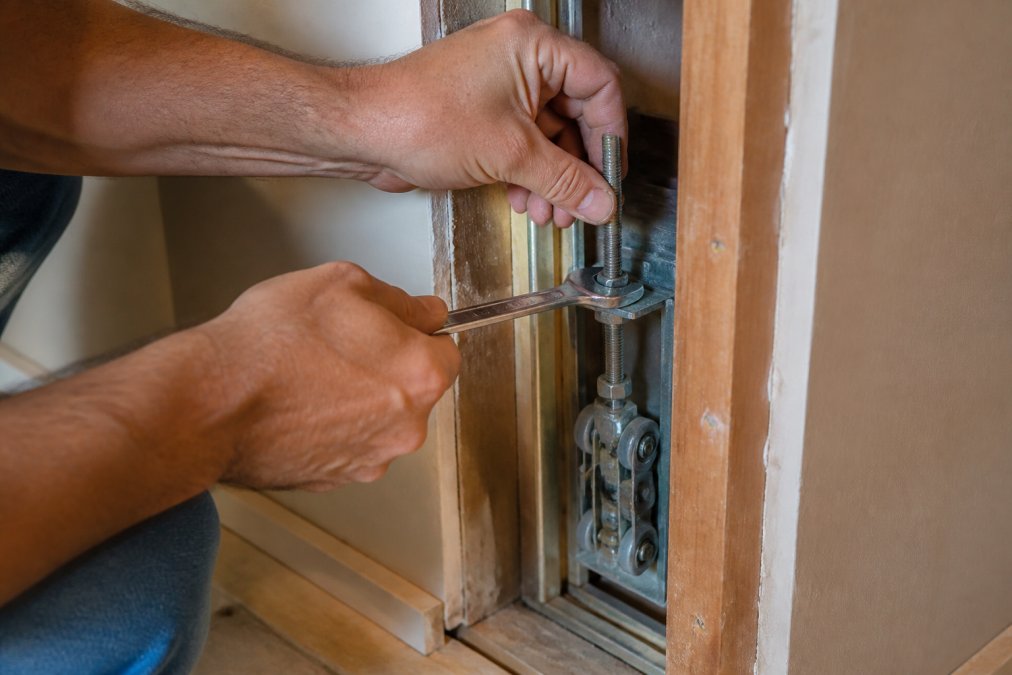
Access the adjustment bolts on the roller assembly, typically on the door frame or inside the wall cavity. A quarter-turn adjustment often solves minor dragging. Check the track for debris and dust; clean with a damp cloth. Never use lubricants on the track, they attract dust. Verify the door panel is straight; a warped panel requires replacement.
If adjustments don’t resolve the issue, the rollers may be worn or the track bent. Professional assessment is needed to diagnose the exact problem and recommend the most cost-effective fix.
Do not force a stuck pocket door. Forcing it can damage the rollers, track, or frame. If the door resists gentle pressure, stop and call a professional. Continuing can turn a simple repair into an expensive replacement.
Pocket Door Roller Replacement Cost and Process
Ball-bearing rollers are the workhorses of any pocket door system. Failure shows up as grinding noises, resistance, or jamming. Replacement requires removing the door panel, replacing the roller assembly, and reinstalling the door. DIY is possible with basic skills, but the confined space makes it challenging. Quality matters: premium rollers last longer and operate more smoothly than budget alternatives.
DIY vs Professional Pocket Door Repair
The decision between DIY and professional repair depends on the problem’s complexity, your skill level, and the risk of making things worse.
DIY makes sense for simple track cleaning, minor adjustments, and handle replacement. These tasks require basic tools and minimal mechanical knowledge. If the problem is clearly a stuck track or loose hardware, attempting a fix yourself saves money.
Professional repair is the better choice when the problem involves the roller assembly, structural components, or drywall damage. Working inside a wall cavity requires precision and proper tools. Mistakes here are expensive to fix. Professional technicians have the experience to diagnose issues quickly and avoid costly errors.
Consider the cost of tools if you don’t already own them.
| Repair Type | DIY Feasibility | Time Required | Risk Level |
|---|---|---|---|
| Track cleaning | High | 15-30 minutes | Low |
| Handle replacement | High | 20-45 minutes | Low |
| Roller adjustment | Medium | 30-60 minutes | Medium |
| Roller replacement | Low | 2-3 hours | High |
| Drywall repair | Low | 4-8 hours | High |
DIY repair works best for homeowners comfortable with basic mechanical tasks and confident in diagnosing the problem correctly. If you’re uncertain about the cause, professional assessment prevents costly mistakes.
When to Repair vs When to Replace Your Pocket Door
The decision framework is straightforward: repair when the problem is isolated to one component, replace when structural integrity is compromised or repair costs approach replacement costs.
Frequently Asked Questions
Are pocket doors expensive to repair?
Pocket door repair costs depend on the problem and wall construction. Simple adjustments like track realignment or roller leveling are often among the most affordable repairs. However, if the door jamb is damaged, drywall requires patching, or structural issues exist within the wall cavity, costs will be higher. A free estimate helps identify exactly what needs fixing and the true cost for your situation.
What is the typical cost to replace a pocket door versus repair it?
Repair costs vary depending on damage severity, while full replacement costs also vary, including labor, materials, and installation. If your door has a derailed roller, misaligned track, or worn ball-bearing hardware, repair is almost always cheaper. Replacement makes sense only if the door frame is severely damaged, the wall cavity has structural issues, or the door has failed repeatedly despite repairs. Request quotes for both options to compare.
Can you repair a pocket door without removing drywall?
Many repairs, track adjustment, roller replacement, guide realignment, and leveling, require no drywall removal. However, if the door jamb is damaged, the rough opening has shifted, or moulding and casing need replacement, drywall access becomes necessary. A technician can assess whether your specific problem allows non-invasive repair or if wall access is required. This distinction significantly affects cost and project scope.
What are the most common pocket door problems and their repair costs?
Derailed doors (roller jumped the track), misaligned or binding doors (stuck or hard to open), worn rollers, damaged door guides or hardware replacement, drywall damage from impact, and track corrosion or debris buildup all have varying repair costs. Identifying the exact problem through inspection determines the repair cost.